"Is that safety glass?" is one of the most common questions we get on a job, and the answer people expect is usually wrong. Homeowners say "tempered" when they mean laminated. They assume the patio door is laminated (it's tempered). And they expect the law to require safety glass in every bathroom window (in Alberta, it usually doesn't).
Tempered, laminated and obscure glass do three different jobs. Tempered glass is about safety: it's much stronger than regular glass, and when it does break it falls apart into small, blunt pieces. Laminated glass is about security and sound: it cracks, but it stays in one piece in the frame. Obscure glass is about privacy, and it can be tempered or laminated as well. This guide explains each one from the installer's side, what the 2023 Alberta building code actually requires (and the American rules that get copied onto Canadian websites), how each type holds up to Calgary hail, and where your glass money does the most good.
The short answer
- Tempered is safety glass. It's about four times stronger than regular glass and breaks into small, blunt pieces. Every new patio door and door slab comes with it.
- Laminated is security and sound glass. It isn't stronger. It cracks like regular glass, but the plastic interlayer holds it together so nothing comes through.
- Obscure is privacy glass. In Canada, almost everyone picks satin or pinhead. Both can be ordered tempered.
- Alberta code requires safety glass in specific places: patio and storm doors, door-like sidelights, large glass in entrance doors, shower and tub enclosures, and glass guards. Not in every low window or bathroom window.
- For hail, glass thickness matters more than glass type. Thin 2.5 mm builder-grade glass is what breaks.
- Don't make every window tempered or laminated. Put each type where it has a job to do.
| Tempered | Laminated | Obscure (privacy) | |
|---|---|---|---|
| What it is | Regular glass heated in a furnace, then cooled fast with air | Two sheets of glass bonded to a plastic interlayer | Glass with a texture or etched finish you can't see through clearly |
| Strength | About 4× regular glass of the same thickness | About the same as regular glass | Same as the glass it's made from |
| How it breaks | All at once, into small, blunt pieces | Cracks like a spider web but stays in the frame | Like tempered or regular glass, depending on how it's ordered |
| Main job | Safety: doors, shower glass, code-required spots | Security, noise, keeping things out | Privacy: bathrooms, entries, side windows |
| Counts as safety glazing? | Yes | Yes | Only if it's also tempered or laminated |
The Mix-Up We Hear Most: Tempered Isn't Laminated
Most of the confusion comes from the phrase "safety glass." People hear it and picture glass that's hard to break into. That's laminated glass. Safety glass, in the code sense, means glass that won't hurt you when it breaks. That's tempered glass, plus laminated glass that has been tested to the same standard.
Your patio door is tempered, not laminated. Standard sliding patio doors on the market today use 4 mm tempered glass. 5 mm is available as a custom upgrade. Laminated glass in a patio door is an extra-cost option, not the default. (Shopping for a premium patio door? See our Urbania vs Loft patio door review.) The same goes for door slabs: every new exterior door and patio door we install comes with tempered glass in the lites. That's the safety standard for doors. If something smashes the glass, like a kid running into it or a slab slamming in the wind, it falls into small pieces instead of long, sharp blades.
Tempered glass is hard to break by accident, not hard to break on purpose. Bumps, thrown balls and slammed doors usually bounce off. But the right sharp tool, the kind firefighters and auto-glass techs carry, shatters a tempered pane in a second. The whole pane goes at once, and the opening is clear.
Laminated glass is the opposite. A hammer or a thrown chair will crack it. But the glass sticks to the interlayer, so the pane stays in the frame as a cracked sheet, and getting through means a lot more work. That's why laminated glass is used for security, and why it's the glass in your car's windshield.
Tempered Glass: The Standard Safety Glass
Tempered glass starts as ordinary float glass. It's cut to size, the edges are finished, and any holes are drilled first. Then it runs through a furnace until it's close to softening and gets cooled fast with jets of air. The outside surfaces cool and set first. The core cools and shrinks afterwards, pulling the surfaces into compression. That locked-in stress is what makes tempered glass about four times stronger than the same glass untreated (Viracon puts it at four times; Guardian at three to four). It's also why tempered glass doesn't crack. When it fails, the stored stress lets go and the whole pane breaks into small, blunt pieces.
Why tempered glass can't be cut or drilled
Once glass is tempered, it can't be cut, drilled or re-edged. Breaking into the surface releases the stress and the pane explodes. So if a tempered unit shows up the wrong size, there's no fixing it on site. It goes back on order, and a remake can take a couple of months. This is one reason we measure twice on any opening that needs tempered glass.
🔩 The foot lock that took out a patio door
Another installer on a job was adding a foot lock to the bottom of a patio door slab, which means a few self-tapping screws into the door frame. He went in a little too close to the glass. The moment the screw touched the edge of the tempered pane, the whole thing let go. Not a crack: the entire pane turned into a net of small pieces in a second. Nobody got hurt, which is exactly what tempered glass is for. We happened to have a spare slab of the same standard size in storage, so the fix was a drive to the warehouse instead of a weeks-long wait for a remake. The lesson: nothing sharp goes near tempered glass. Not screws, not drill bits, not a glass cutter.
Where else you'll find tempered glass
Big glass units. Large picture windows are sometimes built with tempered glass even where no safety rule asks for it. The code requires glass to be designed for the loads on it (Article 9.6.1.3), and a big pane takes a lot of wind. Tempering, or thicker glass, is how manufacturers get the strength. It isn't there to stop breakage. It's there so the glass can handle the size.
Older homes, almost never. When we pull windows out of older Calgary houses, the glass is regular, untempered glass, often only about 2.5 mm thick. Older door slabs sometimes have regular glass too, in exactly the spots where a new door would have tempered.
Can tempered glass break by itself?
It can, but it's rare. The usual cause is a tiny nickel sulfide stone in the glass that slowly changes size and, sometimes years later, cracks the stressed core. Vitro describes it as extremely rare. Heat-soak testing, where tempered glass is reheated (to around 290 °C for a couple of hours) so suspect panes break at the factory instead of in your house, lowers the risk but doesn't eliminate it. For what it's worth: in all our residential work, we've never seen a tempered window or door pane break on its own. Every broken tempered pane we've dealt with had a cause.
Heat-strengthened glass is not safety glass
You may see "heat-strengthened" (HS) on a spec sheet. It's heated like tempered glass but cooled more slowly, so it ends up only about twice as strong as regular glass, and it breaks into large, sharp pieces much like ordinary glass. It has its uses in big commercial glazing, but the Canadian safety glazing standard, CAN/CGSB-12.1, specifically excludes monolithic heat-strengthened glass. If a spot needs safety glass, heat-strengthened isn't it.
Laminated Glass: Security and Sound, Not Strength
Laminated glass is a sandwich: two sheets of glass permanently bonded to a plastic interlayer, usually PVB (polyvinyl butyral). A standard interlayer is about 0.76 mm (0.030 inches) thick. Security builds use thicker or multiple interlayers, or a stiffer ionoplast interlayer (often sold as SGP). In a window, the laminated sheet is one of the panes in the sealed unit, alongside regular or tempered panes.
Myth: laminated glass is stronger
It isn't. Laminated glass doesn't make a window harder to crack. Hail, a hammer or a thrown object will crack it about as easily as regular glass. What's different is what happens next: the interlayer holds the broken glass together, so the hole never opens up. That's why laminated is used where you want the glass to stay put, and tempered is used where you want the glass to be strong and to break safely.
Does laminated glass stop break-ins?
It slows them down. Someone can crack a laminated window, but getting through means beating and cutting through the interlayer, which takes time and makes noise. How much time depends on the build: how thick the interlayer is and how the glass is held in the frame. Keep in mind that the safety glazing standard tests for people falling into glass, not for burglary. A "laminated" label alone doesn't tell you the security level.
We'll be honest. We've seen the demo videos where someone attacks laminated glass and doesn't get through, and they're convincing. But in residential work, we've never had a customer with laminated glass tell us about a real break-in attempt. Laminated security glass is far more common in storefronts than in houses, mostly because of the price. If one window keeps you up at night, like a ground-floor window right beside a door or a basement window facing the alley, that's where laminated earns its money.
Laminated glass for noise
Laminated is also the classic sound-control glass, because the interlayer damps vibration. In our experience, any window sold as a "soundproof" package includes a laminated pane. But laminated alone doesn't make a window quiet, and a noise build isn't the same unit as a security build. For noise, the laminate goes on the room side, where it stays warm (the interlayer damps sound much less when it's cold), and it's paired with thicker glass and a wider air space. The full story, with lab numbers, is in our soundproof windows and STC ratings guide.
Fading is a coating job, not a laminate job
You'll read that laminated glass blocks UV, and it does. Cardinal says its laminated glass blocks over 95% of fade-causing UV. But protecting floors and furniture from fading is mainly the job of the coating. A good Low-E coating already blocks most UV (Cardinal rates LoĒ³-366 at about 95%), often at little or no extra cost when it's specified at order time. If fading is your only worry, choose the coating first and skip paying for laminated. More in our Low-E coating guide.
Which pane gets the laminate?
There's no single answer. For noise, it's the room-side pane. For security or impact, the right position depends on what you're protecting against, the window line, and where the Low-E coatings have to sit. Ask your manufacturer which pane they laminate and why. A clear answer is a good sign.
If someone adds "lamination" after the windows are installed, that's a security film stuck to the inside face of the room-side pane, the only surface they can reach. Film is a different product from factory laminated glass, and how well it works comes down to how well it's applied.
Weight and lead time
Laminated adds glass, so it adds some weight, but on normal residential window sizes we've never had it cause a hardware or hinge problem. Lead time runs close to tempered, maybe a week longer. The price is what makes people think twice: laminated is a special-order option, and not a cheap one.
Obscure Glass: Satin, Pinhead, Rain and Glue Chip
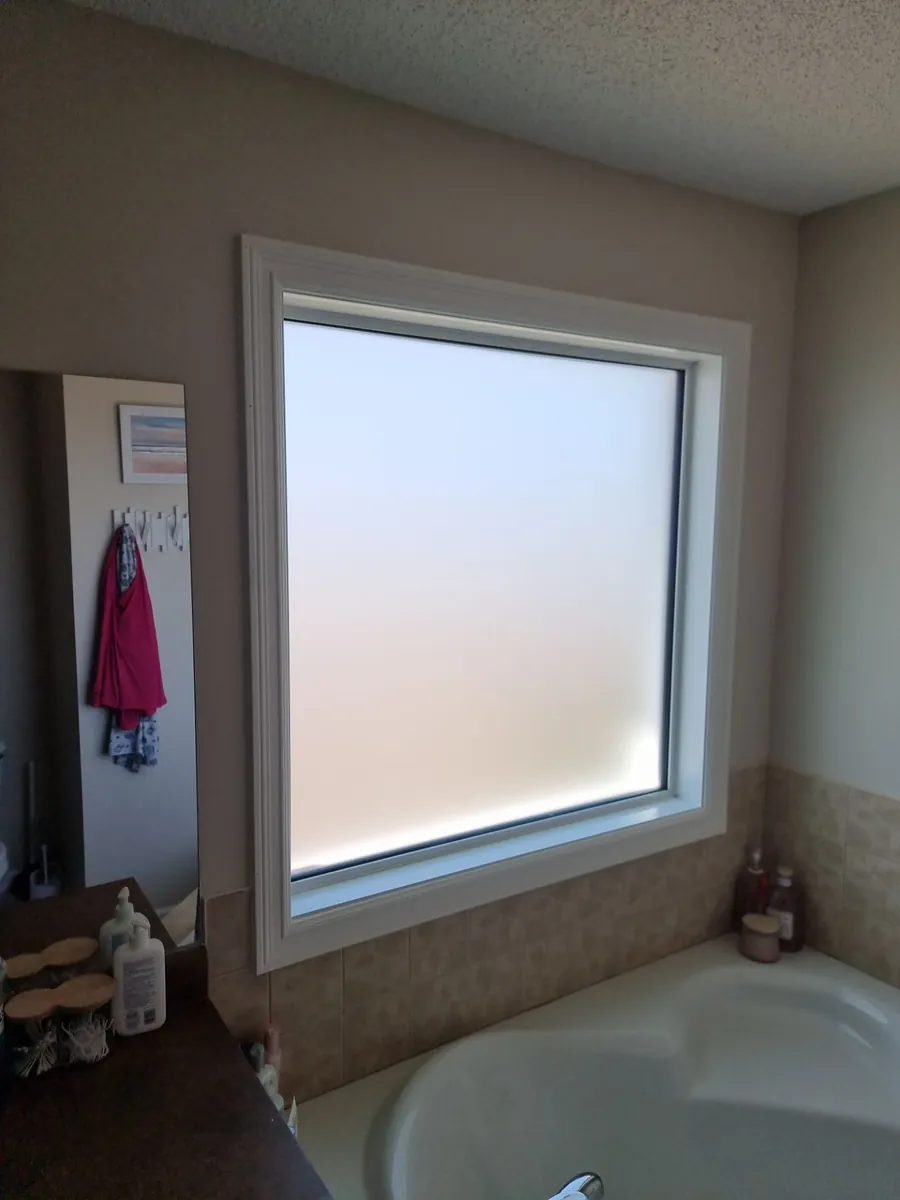
Obscure (privacy) glass lets light in but blurs the view. Glass makers produce dozens of decorative patterns, but in our experience the window manufacturers across Canada come back to the same four: satin, pinhead, rain and glue chip. Two of them, satin and pinhead, are in roughly 99% of the privacy windows we see. There's a good reason for that.
| Pattern | What it looks like | Privacy | Our take |
|---|---|---|---|
| Satin | Smooth, even frosted look with no visible texture (usually acid-etched) | Highest of the four | The most private option. Our first pick for bathrooms. |
| Pinhead | Fine pattern of small dimples, like tiny bubbles | Very high | Almost as private as satin, with a texture you can see. |
| Rain | Vertical streaks, like rain running down glass | Lower: shapes and colours come through | A style choice. Not for the window beside the tub. |
| Glue chip | Frost-flower pattern, like ice ferns on a winter window | Lowest of the four | Decorative. Expect to see shapes and colours through it. |
Why factory obscure glass is easy to clean
On the units we install, the textured or etched face sits inside the sealed unit. Both faces you can touch are flat, smooth glass. There's nothing to collect dust or soap film, and you can scrub them as hard as you like.
Factory obscure glass vs frosted film
Both can work, and film is acceptable as a quick fix or in a rental. But film scratches, its edges can lift, and a poorly applied film can trap moisture and grime behind it. That's not what you want in a bathroom. Factory obscure glass lives inside the sealed unit, so there's nothing to peel, scratch, or grow mould.
Can you see through obscure glass at night?
More than people expect. When the lights are on inside and it's dark outside, the room is the brightest thing around, so shapes and colours show through more. Distance matters too. Someone across the room is a blur, but someone standing right against the glass shows up as a shape. Satin and pinhead hold up well. Rain and glue chip give away a lot more. Some manufacturers rate patterns on a privacy scale, 1 to 5 or 1 to 10, but there's no industry standard, so ask to see a real sample, ideally with a light behind it.
Can obscure glass be tempered?
Yes. Privacy patterns can be ordered as tempered glass, and for a bathroom window beside a tub or shower, tempered satin or pinhead is the combination we'd choose. Safety and privacy, in one sealed unit.
What Alberta's Building Code Actually Requires
Houses in Alberta are built to the National Building Code – 2023 Alberta Edition, which came into force on May 1, 2024. Part 9 covers houses and small buildings, and its glass rules are more specific, and more limited, than most homeowners expect. Here's where it requires safety glazing: tempered or laminated glass that meets the Canadian standard CAN/CGSB-12.1, "Safety Glazing."
| Where | What's required | Article |
|---|---|---|
| Sliding glass doors and storm doors, within or at the entrance to a home | Safety glazing (tempered or laminated) | 9.6.1.4.(1) |
| Sidelights wider than 500 mm that could be mistaken for a door | Safety glazing | 9.6.1.4.(1) |
| Glass in an entrance door, where the glass is larger than 0.5 m² and comes within 900 mm of the bottom of the door | Safety glazing | 9.6.1.4.(2) |
| Shower and bathtub enclosures | Safety glazing meeting Class A of CAN/CGSB-12.1 (new in the 2023 edition) | 9.6.1.4.(6) |
| Glass in guards: glass railings, or glass panels that act as the guard | Safety glazing | 9.8.8.7 |
| Windows near an unenclosed outdoor exit stair that's the only exit from a suite (houses with a secondary suite) | Wired glass in fixed steel frames, or glass block. Tempered and laminated don't qualify. | 9.9.4.4.(1) |
Plain-language summary of NBC 2023 Alberta Edition, Part 9. The code text governs; for permitted work, check with the City of Calgary for your project.
What the code doesn't say
There's no general Alberta rule that every window close to the floor, every window beside a staircase, or every bathroom window has to be tempered. Ordinary windows can legally use regular (annealed) glass, as long as the glass is designed for the size of the window and the wind it will see.
Myth: glass within 18 inches of the floor or 24 inches of a door must be tempered
Those are American rules. The US residential code (IRC section R308.4) lists "hazardous locations" by distance: glass within 24 inches of a door, large panes close to the floor, glass near tubs and showers, and glass near stairs. They're all over the internet, and we've seen Calgary websites present them as what local inspectors require. They aren't in Alberta's Part 9. Tempering a big, low pane in a busy family room is still a sensible choice. It's just a choice, not a code requirement.
The "low window" rule is about falls, not glass
Alberta's code does have a rule about low windows. It just isn't about glass type. Under the 2023 edition, an openable window whose opening part sits less than 900 mm above the floor, with a drop of 1.8 m or more on the outside, needs a guard or an opening-control device. The device has to limit the opening to 100 mm and be releasable only with a tool or special knowledge. (Alberta's STANDATA 23-BCV-001 allows window opening control devices tested to ASTM F2090 for this.) The rule is there to stop kids falling out of upstairs windows. Tempered glass doesn't satisfy it, and it doesn't need tempered glass.
Do bathroom windows need tempered glass?
The code's shower and bathtub rule covers the enclosure: shower doors, glass panels, tub screens. Since May 2024, that glass has to meet Class A, the higher impact class in the Canadian standard (the test drops its impactor from 1,219 mm for Class A, versus 457 mm for Class B). An ordinary window on a bathroom wall isn't singled out by Part 9. Where it gets grey is a window set inside the tub or shower surround itself. If you're doing permitted work, ask your inspector.
Our advice is simpler. If a window sits next to a tub or shower, where someone can slip and fall into it, order it tempered. Add satin or pinhead and you've solved privacy in the same unit.
Windows beside stairs
You'll hear that a window beside a staircase must be tempered. In Alberta, that's another imported American rule. Glass that forms part of a guard at a stair or landing has to be safety glazing, and windows near an outdoor exit stair for a secondary suite have their own fire rule (next). An ordinary window beside an indoor staircase isn't covered.
The secondary-suite rule most people miss
This is the one place we regularly run into special glass on renovations. When a basement suite's only exit is an unenclosed outdoor stair, windows and other unprotected openings within 3 m horizontally of that stair, and less than 10 m below or 5 m above it, have to be protected with wired glass in fixed steel frames or with glass block. The classic case is a basement entrance stair that runs right under the living room window. This is a fire rule. Tempered and laminated glass don't count, and "fixed" means the window can't open.
The City of Calgary's Advisory B23-012 explains how the City applies it, including alternatives such as an interior fire shutter, or sprinklers through an alternative-solution application. On the jobs we've seen, owners either switch to a fixed wired-glass window or rework the stair. Either way, sort it out at the permit stage, before you order windows.
Existing homes: the code applies to new work
Building codes apply to new construction and permitted work. They don't force you to bring an older house up to today's rules, and a 2x4-wall house from decades ago can never fully match a new one. Plenty of the glass in Calgary's older homes would fail today's requirements. And in our experience, on a window replacement nobody checks what glass goes into the bathroom window, and home inspectors on a sale rarely look at glass type. It's up to you and your installer, which is exactly why it's worth deciding on purpose.
How to Tell What Glass You Have
The honest answer from the job site: without a mark or a label, it's hard. Here's what to look for.
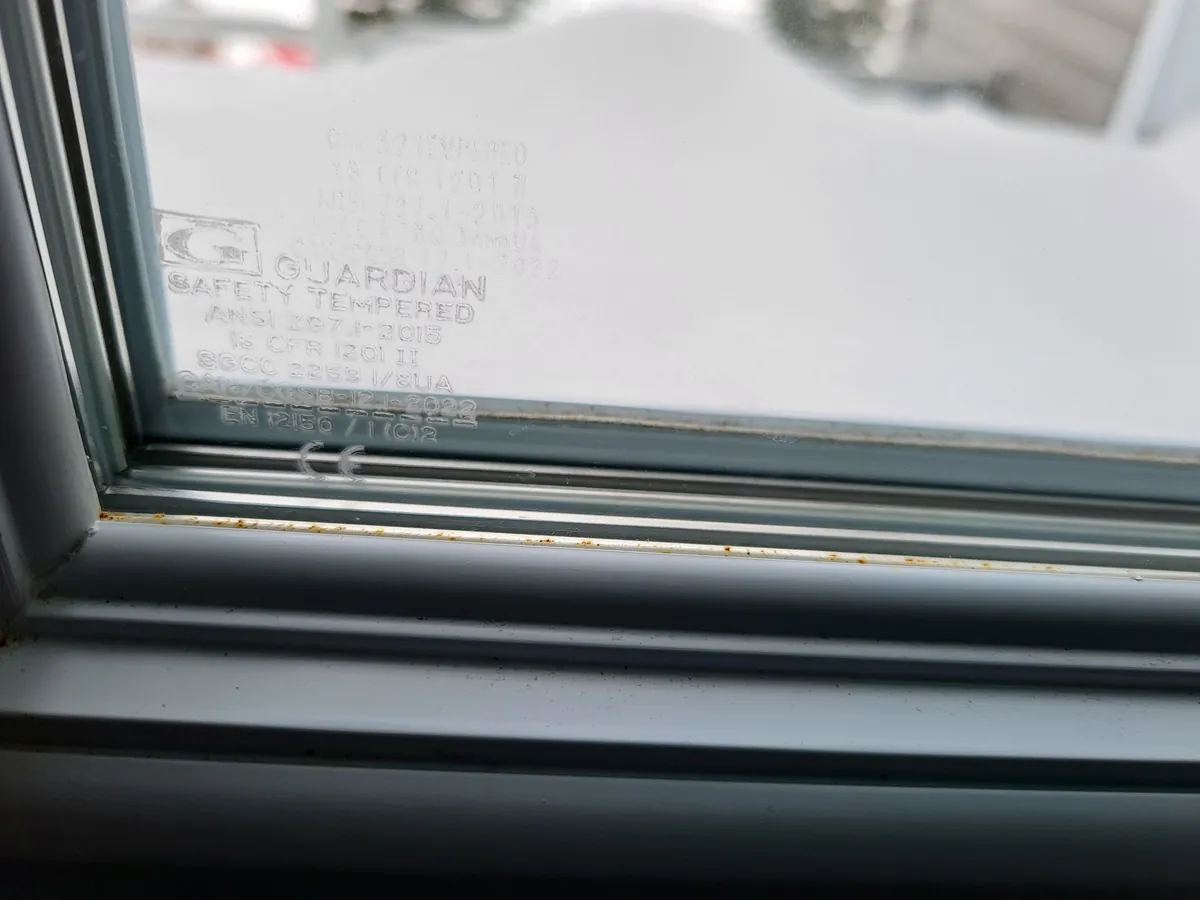
The safety glass mark (the "bug")
Tempered and laminated safety glass is supposed to carry a permanent mark, usually etched or fired into a corner of the pane. Under CAN/CGSB-12.1, the mark shows the maker's name or logo, the standard ("CAN/CGSB-12.1" plus the edition year), and letters for the test size and the impact class (A or B). Glass sold on both sides of the border often carries US marks as well, such as ANSI Z97.1 or CPSC 16 CFR 1201. For tempered glass, the mark is applied by the company that makes the finished, cut-to-size piece.
A bug that says CAN/CGSB-12.1 is the best evidence you'll get. No bug isn't proof of anything, though. In sealed window units, the mark can be missing, or hidden under the frame.
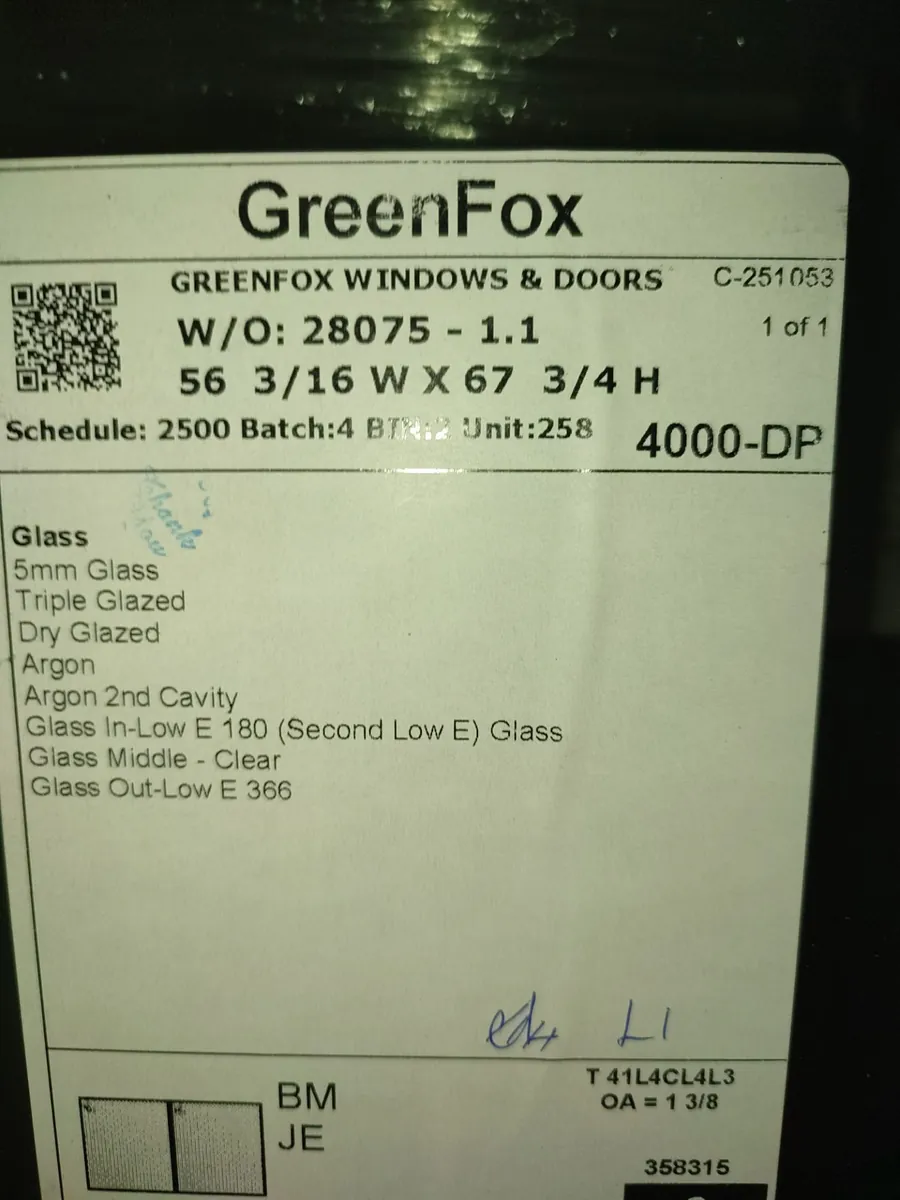
The label on new windows
New windows and doors arrive with a label on the glass that lists the build: double or triple, the coatings, and special glass like tempered or laminated. It's the easiest place to confirm what you bought. Without that sticker, there's no reliable way to tell the laminate thickness or the security level just by looking.
Two quick checks
Look at the edge. On laminated glass, you can sometimes see the thin plastic layer between two sheets. Try polarized sunglasses. Looking through tempered glass at an angle with polarized lenses often shows faint dark spots or stripes, the pattern left by the air jets during tempering. Neither check is foolproof.
📋 Three windows out of twenty-five
It happens: on one order of about twenty-five windows, three arrived with the wrong coating. Nobody was trying to cut corners. Production lines make mistakes. That's why we tell every customer the same thing: on delivery day, before the stickers come off, take a photo of the glass label on every window and door, and compare them with your quote. If a line on the sticker means nothing to you (U-factor, VT, a coating code), ask your installer to walk you through it, or run the photo past an AI assistant for a plain-language explanation and then confirm with the company. Five minutes with your phone is how you know you got what you paid for.
Calgary Hail: Glass Thickness Beats Glass Type
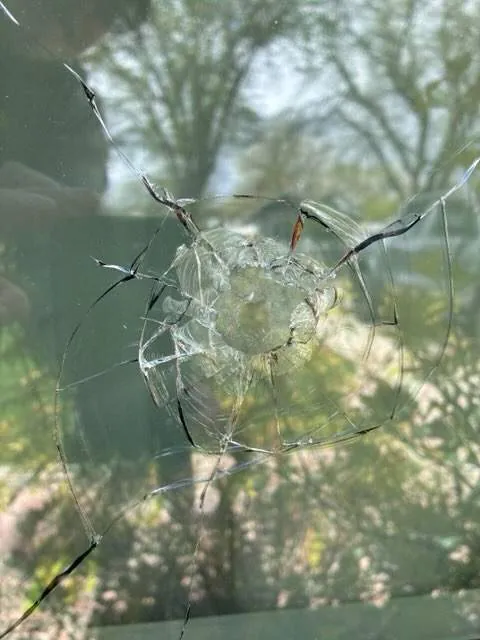
Calgary sits in one of the most active hail regions in Canada, and two recent storms show what's at stake. The June 13, 2020 storm over northeast Calgary and Airdrie caused about $1.2 billion in insured damage. The August 5, 2024 storm, again in the northeast, was first estimated at about $2.8 billion and later revised to about $3.25 billion. Both rank among the costliest disasters in Canadian history, and broken windows and shredded siding were everywhere.
Nobody publishes data on which glass types survived those storms. Here's what we've seen on the ground:
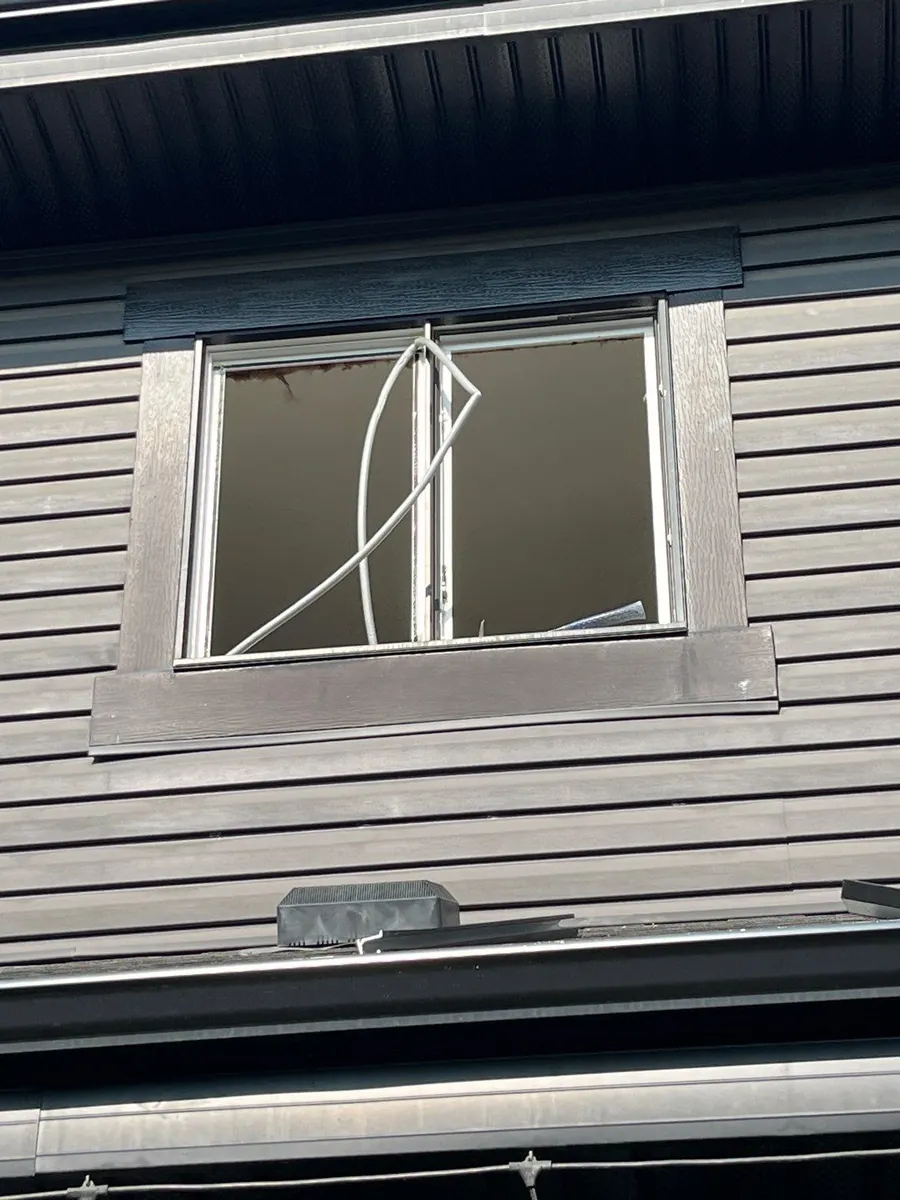
- The windows that break are thin. The worst pictures from the northeast came from newer neighbourhoods full of builder-grade windows with about 2.5 mm glass. That glass breaks in a big hailstorm almost every time.
- 3 mm glass holds up far better. Replacement windows typically use 3 mm glass as a minimum, and even 3 mm is hard for hail to break. 4 or 5 mm is decent strength.
- Tempered is the strongest option. If you want peace of mind against hail, tempered is the right call. For most homes it's overkill.
- Laminated is the wrong tool for hail. Hail can still crack it. The interlayer only stops the hail from coming through, which matters more in a storm that throws debris than in a normal hailstorm. Cracked laminated glass still needs replacing.
🧊 Same wall, same windows, different glass
One house we'd worked on had new sliders in the upstairs bedroom with 3 mm glass, while the basement still had the original builder sliders. Same wall, same size, same style of window. After a hailstorm, the old basement windows were broken. The new upstairs windows weren't. The only real difference between them was the glass.
If hail is your worry, ask what glass thickness your quote includes before you ask about anything else. Thin 2.5 mm glass is the weak point, and it's still going into new houses. Our builder-grade windows article explains why.
Chinooks and Stress Cracks: Thickness and Seals Matter More Than Tempering
You'll sometimes hear that tempered glass protects a window from Chinook temperature swings. In our experience, that's mostly a myth. What Chinooks attack is the sealed unit. Every swing makes the glass and the gas inside expand and contract, the panes flex, and the edge seal takes the punishment. Vibration from heavy trucks on a nearby road adds more. What helps is thicker glass that flexes less, plus a good spacer and seal.
Glass makers do rate heat-treated glass higher for resisting thermal-stress cracks, so tempering isn't useless. But the Chinook failures we replace are almost always seals, not cracked panes. And either way, a cracked pane or a fogged unit, the fix is the same: replace the whole sealed unit, not one pane. More on this in our articles on Chinook damage to windows and glass unit spacers.
Which Glass Goes Where: A Room-by-Room Plan
Every window in a house can look the same and still be built differently. Clear glass looks like clear glass; what changes is what's inside the sealed unit. You don't need every window tempered or every window laminated, and paying for that buys features most windows will never use. Put each type where it has a job:
| Location | What we'd put there | Why |
|---|---|---|
| Patio and sliding doors | Tempered (4 mm standard, 5 mm upgrade) | Required by code, and standard on every new patio door |
| Entry door glass and sidelights | Tempered | Code covers large door glass and door-like sidelights; new doors come tempered anyway |
| Shower and tub enclosures | Class A safety glazing | Required by code since May 2024 |
| Bathroom window beside a tub or shower | Tempered + satin or pinhead | Safety where someone can fall, privacy, easy to clean |
| Ground-floor window beside a door, or a basement window facing the alley | Laminated, if break-ins worry you | Cracks but holds together |
| Bedroom facing a busy street | Thicker glass, or laminated on the room side | Noise. See our STC guide. |
| Large picture window | Thicker or tempered glass, as the manufacturer specifies | Strength for the size and wind load |
| South- and west-facing rooms | The right Low-E coating | Heat gain and fading are a coating job |
| Window near a secondary suite's outdoor exit stair | Wired glass in a fixed steel frame or glass block (or redesign) | Fire rule, 9.9.4.4. Tempered doesn't count. |
One more thing we tell our own families: triple-pane isn't the answer to everything. Ask what kind of triple-pane you're getting (glass thickness, overall unit thickness, coatings), because some triples don't do the job you're paying for. Our triple-pane vs double-pane comparison covers when the third pane pays off.
What It Costs, and How Long It Takes
Prices depend on the manufacturer, the window sizes and the size of the order, so rather than invent per-window numbers, here's the relative picture from our Calgary quotes:
| Glass option | Relative cost | Lead time |
|---|---|---|
| Tempered | Roughly 10–20% more on the glass order, depending on thickness (3, 4 or 5 mm) and size | Standard production |
| Laminated | A special-order option, and not a cheap one | Close to tempered, maybe a week longer |
| Obscure (satin or pinhead) | Priced per pattern by each manufacturer; ask for it on your quote | The standard patterns, so the easiest to get |
| Remake of a wrong-size tempered unit | A full new unit | Can take a couple of months |
If the budget is tight, spend where the job is: tempered where safety needs it, laminated only where security or noise is a real problem, and the right Low-E coating for heat and fading. For full installed prices, see our Calgary window replacement cost guide.
What to Put on Your Quote
Get these in writing before you sign:
- The glass type for each opening: regular, tempered, laminated or obscure, listed window by window. Not "safety glass where required."
- The thickness of each pane. 3 mm at a minimum; 4–5 mm where you want strength or quiet. Avoid 2.5 mm.
- Patio door glass: tempered as standard. Ask whether it's 4 mm or a 5 mm upgrade.
- For laminated: which pane is laminated, and what kind of interlayer (standard, acoustic or security).
- For obscure: the pattern name (satin, pinhead, rain or glue chip) and whether it's tempered. Ask to see a sample.
- The Low-E coating names. That's what handles heat and fading.
- A delivery check: photograph every glass label on delivery day and compare it with the quote before the windows go in.
If a salesperson can't tell you which windows are tempered, or how thick the glass is, you're buying a label, not a spec. More on reading the fine print in how to read a window quote.
FAQ
Is laminated glass better than tempered glass?
They do different jobs. Tempered glass is about four times stronger than regular glass and breaks into small, blunt pieces, which is why it's the standard safety glass for doors and shower enclosures. Laminated glass isn't stronger, but its plastic interlayer holds the glass together when it cracks, so it's the better choice for security and noise. Both count as safety glazing under the Canadian standard CAN/CGSB-12.1.
Do bathroom windows need tempered glass in Alberta?
Alberta's building code requires Class A safety glazing for shower and bathtub enclosures, but it doesn't single out ordinary bathroom windows. If a window sits beside a tub or shower where someone could slip and fall into it, we recommend ordering it tempered anyway and adding a satin or pinhead privacy pattern in the same sealed unit. For a window inside a tub or shower surround on permitted work, confirm with your inspector.
Is the glass in a patio door tempered?
Yes. Glass in sliding doors at the entrance to a home has to be safety glazing under Alberta's code, and new patio doors come with tempered glass as standard, usually 4 mm thick, with 5 mm available as a custom upgrade. Laminated glass in a patio door is an extra-cost option, not the default.
How can I tell if my window glass is tempered?
Look for a permanent mark in a corner of the pane that names the maker and the safety glazing standard, such as CAN/CGSB-12.1, often alongside US marks like ANSI Z97.1. New windows also come with a glass label that lists the build. Without a mark or a label it's hard to be sure. Polarized sunglasses sometimes show the faint pattern left by tempering, but that test isn't foolproof.
Can you see through obscure glass at night?
Shapes and colours show through more at night when the lights are on inside, and more when someone stands right against the glass. Satin and pinhead patterns stay very private. Rain and glue chip patterns reveal much more. Look at a real sample with a light behind it before you order.
Which window glass holds up best to hail in Calgary?
Glass thickness matters most. Builder-grade windows with about 2.5 mm glass are the ones that break. 3 mm glass is much harder for hail to break, and 4 to 5 mm is stronger again. Tempered glass is the strongest choice if you want peace of mind. Laminated glass can still crack in hail; it only stops the hail from coming through.
Can tempered glass be cut or drilled?
No. Tempered glass has to be cut, edged and drilled before it's tempered. Cutting or drilling it afterwards releases the stress built into the glass and the whole pane shatters, so a wrong-size tempered unit has to be remade.
The Bottom Line for Calgary Homeowners
- Tempered is for safety. It's standard in doors and required wherever Alberta's code calls for safety glazing.
- Laminated is for security and sound. It cracks like regular glass but holds together. Don't buy it for fading; that's the coating's job.
- Obscure is for privacy. Satin and pinhead do the job in almost every bathroom. Order them tempered beside a tub or shower.
- Alberta's code is narrower than the internet says. The 18-inch and 24-inch rules are American. Secondary-suite exit stairs are the exception people miss.
- For hail, buy thickness. Thin builder-grade glass is what breaks.
- Match the glass to the window. Windows that look the same can be built for completely different jobs.
Not sure what glass your quote includes?
Send us the glass details from your quote or the labels on your windows: thickness, coatings, tempered or laminated, and which rooms they're for. We'll tell you plainly whether it's the right glass in the right places, and where you can save.
Ask a QuestionWhere the facts in this article come from
- National Research Council Canada, National Building Code – 2023 Alberta Edition — Part 9, Articles 9.6.1.3, 9.6.1.4, 9.8.8.1, 9.8.8.7 and 9.9.4.4. In force May 1, 2024.
- Government of Alberta Part 9 code-change comparison, published by BILD Alberta — the Class A shower and bathtub change and the 900 mm window opening rule.
- Alberta Municipal Affairs, STANDATA 23-BCV-001 — window opening control devices (ASTM F2090).
- City of Calgary, Advisory B23-012 — protection of openings near unenclosed exterior stairs and ramps.
- Canadian General Standards Board, CAN/CGSB-12.1, Safety Glazing — what counts as safety glazing, impact classes and marking. Class drop heights as summarized by Construction Canada.
- Guardian Glass, Heat-strengthened vs tempered glass, and Viracon, Heat treatment — strength, breakage pattern and heat-soak testing.
- Vitro Architectural Glass, Nickel sulfide and spontaneous breakage.
- Cardinal Glass Industries, Laminated glass fade protection — UV blocking.
- Insurance Bureau of Canada on the June 2020 and August 2024 Calgary hailstorms; Insurance Journal on the revised 2024 estimate.
- International Residential Code, Section R308.4, Hazardous Locations — the US rules quoted for comparison only.
Related Articles
Window STC Ratings & Soundproof Windows
Where laminated glass, thicker glass and air space actually cut noise.
Low-E Coating Explained
The coatings that handle heat, comfort and fading in Calgary windows.
The Builder-Grade Window Loophole
Why thin-glass windows still go into new Calgary houses.
How to Read a Window Quote
What every line on a quote means, and the red flags to push back on.