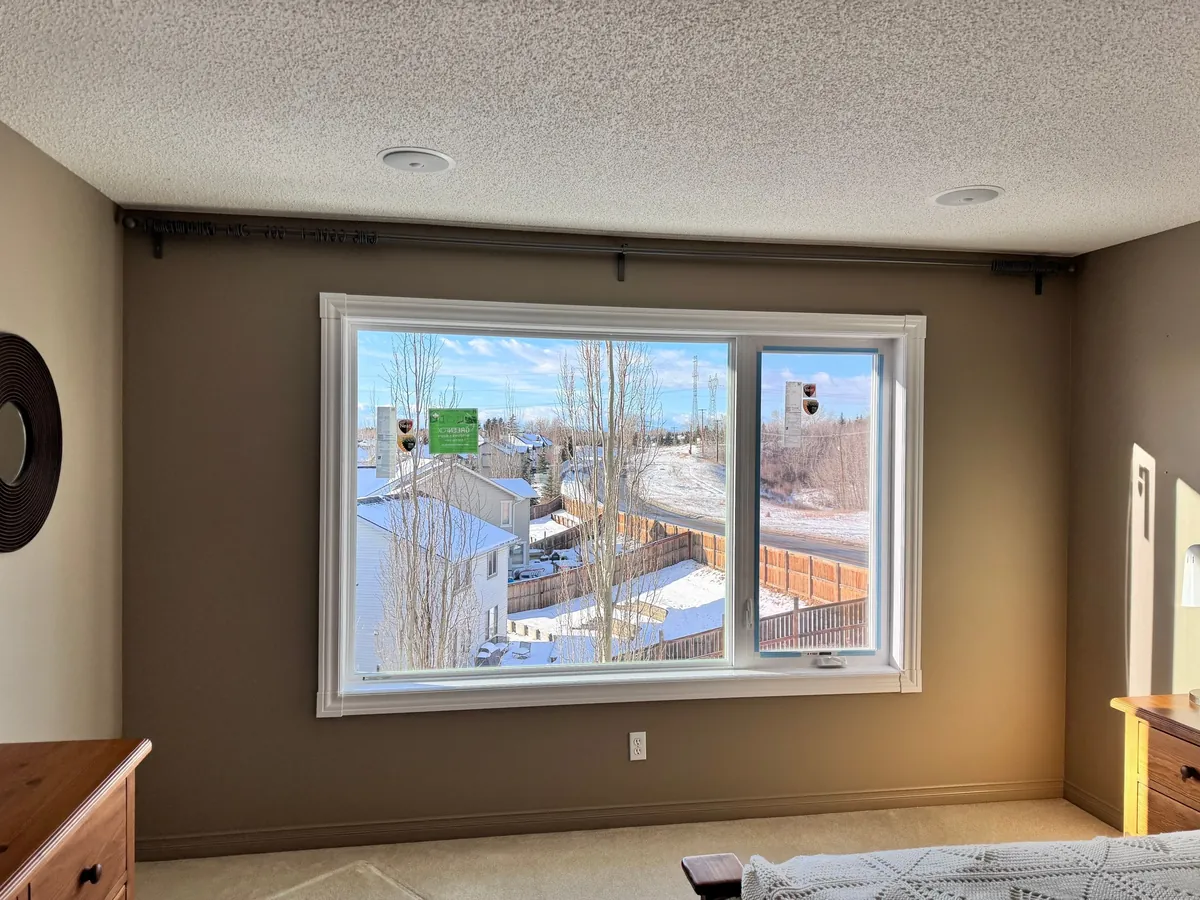
Nobody calls us asking for an "STC 38 window." They call because a neighbour warms up his work truck and air tools at six in the morning, because they can hear Deerfoot from their bed, or because the train goes by and the whole house hums. People describe noise by the one sound they can't stand anymore — and that's the right place to start.
New windows can make a house a lot quieter. But a surprising amount of what gets sold as "soundproof" does very little for noise, and some of the most effective upgrades never make it into the brochure. This guide covers what actually stops sound, what's marketing, how to read STC and OITC ratings, where triple-pane helps and where it barely does, and what to put on your quote. It's written from the installer's side of Calgary noise jobs and checked against the glass manufacturers' own published lab data.
The short answer
- Nothing is soundproof. Good windows make a room much quieter. They never make it silent.
- The glass package matters more than the number of panes. Total glass thickness, the width of the air spaces and laminated glass are what stop sound. Argon and krypton do nothing for noise.
- A triple-pane squeezed into a 7/8-inch unit performs about like an ordinary double-pane. A proper 1-3/8-inch triple is a real step up.
- For traffic, trains and aircraft, ask for the OITC rating, not just STC.
- Sliders are the wrong window for a noise job. Fixed and casement windows seal far better.
- A bad install undoes all of it. You can't soundproof a hole.
Nothing Is Soundproof. Here's What Windows Can Actually Do
"Soundproof window" is a sales phrase. No window — and no wall — lets zero sound through. Everything in this article is noise reduction. The useful questions are how much reduction you'll get, and whether you'll notice it.
Here's how changes in sound level are generally perceived, based on the rules of thumb used in window-industry acoustic guidance (AAMA) and in highway noise programs:
| Change in sound level | What it sounds like |
|---|---|
| 1 dB | Not noticeable |
| 3 dB | Just barely noticeable |
| 5 dB | Clearly noticeable |
| 10 dB | About half as loud |
| 20 dB | About a quarter as loud |
Rating points and the decibels that reach your ear aren't exactly the same thing, but this scale tells you which differences matter. A 1- or 2-point gap between two windows is something you read on a spec sheet. A 5-point gap is something you hear.
The encouraging part: the jump from a tired builder-grade window to a well-built, well-installed modern one is often big enough to surprise people. Customers regularly tell us their house sounds like a different house after the install — even with a standard triple-pane and no special acoustic glass.
Why the Window Is Usually the Weak Spot
A typical Calgary exterior wall — 2x4 or 2x6 studs, insulation, sheathing, siding or stucco outside, drywall inside — has a lot of mass and a lot of dead space in it. A window is a few millimetres of glass. When a room is loud, the sound is almost always coming in through the windows and doors first.
And most Calgary houses have the weakest version of the window. Builder-grade windows in new construction are built to be just good enough to pass inspection and outlast the builder's warranty. When we pull them out, we typically find double-pane units with glass around 2.5 mm thick, a narrow air space, a metal spacer, and seals that have been wearing for years. That's roughly 5 mm of total glass between your bedroom and the road. (If you've wondered how those windows still carry an energy rating, see the builder-grade energy rating loophole.)
If you replaced the window with wall, you'd get the best soundproofing there is — but a house needs windows. So the goal is to make the windows and doors behave as much like the wall as practical.
STC vs OITC: Use the Number That Matches Your Noise
STC (Sound Transmission Class) is the number you'll see if a window company quotes an acoustic rating at all. The glass or window is tested in a lab under ASTM E90, and the results are turned into one number using ASTM E413. The catch is what STC was designed for: indoor noise like speech, TV and radio, measured from 125 to 4,000 Hz. ASTM E413 itself says the method is not appropriate for "transportation noises such as motor vehicles, aircraft and trains."
OITC (Outdoor-Indoor Transmission Class), from ASTM E1332, uses the same lab test but scores it against a blend of freeway, railway and aircraft noise, and it reaches lower — down to 80 Hz. That low end is the diesel rumble and jet roar that STC mostly ignores.
So the same glass can look good on one scale and ordinary on the other. Cardinal's acoustic bulletin rates a double-pane unit with two 6 mm panes and a 13 mm air space at STC 35 but OITC 30. Window-industry guidance (AAMA) says OITC usually runs 5 to 10 points below STC. If your problem is traffic, trains or aircraft, OITC is the more honest number.
| The noise you're fighting | What it's made of | Rating to compare |
|---|---|---|
| Neighbours talking, barking dogs, a school playground, a TV next door | Mid and high frequencies | STC is a fair guide |
| Leaf blowers, lawn mowers, air tools | Mixed | STC works; OITC is better |
| Deerfoot, Stoney, Crowchild or Glenmore traffic, trucks, engine brakes | Low-frequency rumble | OITC |
| Freight trains and the CTrain | Low frequency plus vibration | OITC — and expect limits |
| Aircraft near YYC | Low frequency, much of it through the roof | OITC, plus the roof and attic |
Two things to know before you compare ratings
- Most residential window makers don't publish OITC, and many don't publish STC. The NFRC energy label on a window carries no acoustic rating at all.
- Glass numbers are not window numbers. Glass makers publish lab results for the glass alone. Once that glass is in a frame with seals and hardware, the whole window usually rates lower — Cardinal's bulletin says the assembly rating "will typically be reduced from the base glass acoustical rating." Ask whether a quoted number is for the glass or the whole window, and which test it came from.
Where Calgary Noise Calls Come From
Noise calls come from all over the city: the northeast under the YYC flight paths, homes near Deerfoot, Stoney Trail, Crowchild and Glenmore, houses along the rail lines, and plenty of ordinary neighbourhood noise — a work truck idling at dawn, leaf blowers, a neighbour's air compressor.
In most suburbs, builders put a sound fence or berm along the big roads and set the houses back, which takes the edge off at ground level. The exception is a second floor that sits above the fence line. An upstairs bedroom looking over the fence at the traffic gets all of it.
🛣️ The bedroom that stopped hearing Deerfoot
One of our jobs in McKenzie, in the southeast: a two-storey whose back fence sits roughly 50 metres from eight lanes of Deerfoot. The fence protected the main floor, but the upstairs bedroom looked straight out over it at the traffic. We replaced the original double-pane vinyl windows with a standard triple-pane — 3 mm glass on all three panes, a foam spacer, a proper 1-3/8-inch unit, foamed in carefully. Nothing special was ordered for noise, and a window crew spends all day around drills and saws, so nobody was even thinking about it. When the foam was done, the homeowner — an older gentleman who'd lived beside that highway for years — walked into his bedroom and told us it was the first time he couldn't hear Deerfoot. That job is a big part of why we pay attention to noise on every install now.
What the City will and won't do
If you're hoping for a noise wall: Calgary's Noise Barrier Program only covers ordinary road traffic, where noise exceeds 60 dB averaged over 24 hours on regular roads, or 65 dB during the peak hour on truck routes. The City states that noise from "airplanes, engine retarder brakes, or construction activities" does not qualify. And because Deerfoot Trail and Stoney Trail are provincial highways, barrier requests there go to Alberta Transportation and Economic Corridors, not the City.
Near the airport, the Airport Vicinity Protection Area limits new residential development in the NEF 30+ zones, and the Alberta edition of the National Building Code requires extra sound insulation for new buildings there. Look at the example the City gives for windows: "increased thickness of both glass and interpane spacing for double glazed units." Thicker glass and wider spacing — not an extra pane, and not a special gas. Those requirements apply to new construction. If you're replacing windows in an existing northeast home, there's no acoustic requirement; the upgrade is your call.
What Actually Stops Sound Through Glass
Sound gets through a window by shaking the glass. Everything that works either makes the glass harder to shake or stops the vibration from passing from one pane to the next. Five things do that, and the lab tables and our jobs agree on all of them.
1. More glass
Think of it like armour: the thicker the plate, the less gets through. An old builder-grade double-pane with two 2.5 mm panes puts about 5 mm of glass in the way. A triple-pane with 5 mm glass on every pane — possible in a fixed window — puts 15 mm in the way. Three times the glass.
The lab data agrees on the direction, with one caveat: the gains are real but not proportional. In Cardinal's tables, going from 3 mm to 6 mm glass in the same double-pane unit raises the rating from STC 31 to STC 35 (OITC 26 to 30). That's a clearly noticeable improvement — but doubling the glass doesn't make the room twice as quiet.
2. Wider air space between the panes
The air between two panes behaves like a spring connecting them. In a narrow space it's a stiff spring, and the panes shake together at a resonance that NRC Canada places at 200 to 400 Hz for typical factory-sealed double glazing — right in the range of traffic rumble. Widen the space and that resonance drops lower, below more of the noise. Same glass, different spacing, from Cardinal's bulletin:
- 3 mm / 6.5 mm air / 3 mm: STC 28, OITC 25
- 3 mm / 13 mm air / 3 mm: STC 31, OITC 26
- 3 mm / 19.5 mm air / 3 mm: STC 33, OITC 28
This is also why European windows tend to be quieter out of the box. In our experience they commonly use glass units close to 2 inches thick with 4 mm glass as standard, compared with the 1-3/8-inch triple that's typical in Canada. European windows vary like any others, so check the actual glass build.
3. Two different glass thicknesses
Every sheet of glass has a frequency where it lets sound through much more easily — acousticians call it the coincidence dip. Two panes of the same thickness share the same weak spot, so they fail together. Pair two different thicknesses, such as 3 mm and 6 mm, and the weak spots don't line up. NRC Canada's guidance is that a thickness ratio of about 2 works best.
Viracon's acoustic tables show the effect with the same total amount of glass: two 5/16-inch panes rate STC 37 / OITC 32, while a 1/4-inch pane paired with a 3/8-inch pane rates STC 39 / OITC 34. Same glass weight, 2 points better on both scales. It's the classic acoustic glass unit and it works — though in our experience, more total glass is the bigger lever you'll actually hear. In a triple, making the two air spaces different widths works on the same principle.
4. Laminated glass
Laminated glass is two sheets bonded together with a plastic interlayer (PVB). The interlayer damps the vibration — it takes the ring out of the glass — which is why laminated glass is the traditional sound-control glass. Guardian's published data shows the effect: a double-pane unit with two 6 mm panes and a 1/2-inch air space rates STC 34 / OITC 29. Make the room-side pane a laminate with standard PVB and it rates STC 39 / OITC 33. Use acoustic-grade PVB and it's STC 41 / OITC 35.
One Calgary-specific catch: the interlayer damps best when it's warm. NRC Canada warns that at typical Canadian winter temperatures, the benefit of lamination "may be drastically reduced." That's a good reason to ask for the laminated pane on the room side of the unit, where it stays warm. If you're weighing laminated against tempered for safety or security rather than noise, see our guide to tempered vs laminated vs obscure glass.
5. Airtight seals and a sealed installation
Sound follows air. A gap around a sash or a void in the foam lets sound walk around all that glass. This matters so much it gets two sections of its own below: frame style and installation.
What about the spacer? Warm-edge foam spacers are chosen mainly for thermal reasons, but in window-industry testing a foam spacer also scored 2 STC points better than a rigid metal U-channel, with no change in OITC. It's a small factor next to glass and air space. More in our window spacers guide.
Is Triple-Pane Quieter? It Depends on How Thick the Unit Is
This is the question we get most, usually from someone who's been told to "just go triple-pane for the noise." The answer depends almost entirely on the thickness of the glass unit.
Myth: three panes are always quieter than two
NRC Canada put it plainly decades ago: triple glazing "provides essentially the same noise reduction as double glazing, unless the interlayer separation is very large." A third pane only helps if there's room for real air spaces — or if the panes get thicker.
A 7/8-inch triple is mostly marketing
Some triple-pane units squeeze three thin panes into a 7/8-inch (22 mm) unit. The panes sit so close together that there's barely any air between them. Cardinal's own acoustic bulletin shows what that buys you:
| Glass unit | Overall thickness | STC | OITC |
|---|---|---|---|
| Double: 3 mm / 13 mm air / 3 mm | 19 mm (3/4") | 31 | 26 |
| Triple: 3 / 6.5 / 3 / 6.5 / 3 mm | 22 mm (7/8") | 31 | 25 |
| Triple: 3 / 13 / 3 / 13 / 3 mm | 35 mm (1-3/8") | 34 | 27 |
| Double: 6 mm / 13 mm air / 7 mm laminated | 26 mm (about 1") | 40 | 33 |
Source: Cardinal Glass Industries, Technical Service Bulletin IG09. Glass-only lab ratings; a complete window typically rates lower.
Read the second row again. A triple-pane in a 7/8-inch unit rates the same STC as an ordinary double-pane, and one point worse on OITC. You pay for a third pane and get nothing you can hear.
A proper 1-3/8-inch triple is a real upgrade
Space the same three 3 mm panes out into a 1-3/8-inch unit — now the common standard for triple-pane in Canada — and it gains 3 STC points over the double. That's the unit our McKenzie customer got, and together with new compression seals and a sealed install, it was enough for him to stop hearing Deerfoot. Move that triple up to 4 mm glass and it improves again; 5 mm glass in the fixed windows improves it further.
How a triple compares with a laminated double
Here's where we'll be straight with you. On STC, a plain triple and a laminated double with a similar amount of glass land close together in the published tables — usually 2 to 4 points apart, around the edge of what you can hear. On OITC, the low-frequency number, the laminated unit pulls ahead by 4 to 6 points, which you can hear:
| Glass build (glass-only lab ratings) | STC | OITC | Source |
|---|---|---|---|
| Triple: 6 / 1/2" air / 6 / 1/2" air / 6 mm | 37 | 29 | Guardian |
| Double: 6 / 1/2" air / 6 mm, room-side pane laminated (standard PVB) | 39 | 33 | Guardian |
| Double: same build with acoustic PVB | 41 | 35 | Guardian |
| Triple: 1/4" / 1/2" / 1/4" / 1/2" / 1/4" | 39 | 31 | Viracon |
| Double: 1/4" / 1/2" air / laminated 3/16" + 3/16" | 42 | 36 | Viracon |
| Triple with one laminated pane | 41 | 33 | Viracon |
So why do we still put most Calgary customers in a triple? Because in Calgary, noise is rarely the only problem. A laminated double insulates like any other double-pane, while a triple carries roughly half again the insulating value (see our triple-pane vs double-pane comparison). A properly built 1-3/8-inch triple does a big share of the noise job and a much better heat job, for about the same money as a laminated double or a little less. For most homeowners who want "a lot quieter" rather than "as quiet as physically possible," that's the better trade — and we haven't had a customer come back disappointed with a properly built triple on noise.
If noise really is the priority, you don't have to choose. A triple-pane unit with one laminated pane gives you triple-pane insulation and laminated damping in the same window. It's the newest and most expensive glass option in the Calgary market right now.
Argon and Krypton Do Nothing for Noise
People still ask whether argon or krypton will make a window quieter. It won't. Gas fill is a thermal feature. Cardinal's bulletin says "argon filling has no measurable effect on acoustical properties," and in window-industry testing, adding argon left the STC unchanged and moved the OITC by a single point.
While we're on the subject, be sceptical of krypton claims in general. Almost every residential window on the market uses argon. When customers tell us another company promised them krypton, we ask how they'd verify it. Nobody has had an answer yet — you can't tell by looking, and the company making the promise should be the one explaining how to check. Any gas also slowly diffuses out of a sealed unit over the years, while a Low-E coating stays put. If you want more insulation, a second Low-E coating usually gets you more for less than krypton does. More on that in our Low-E coating guide.
Frame Style: Why Sliders Waste Money on a Noise Job
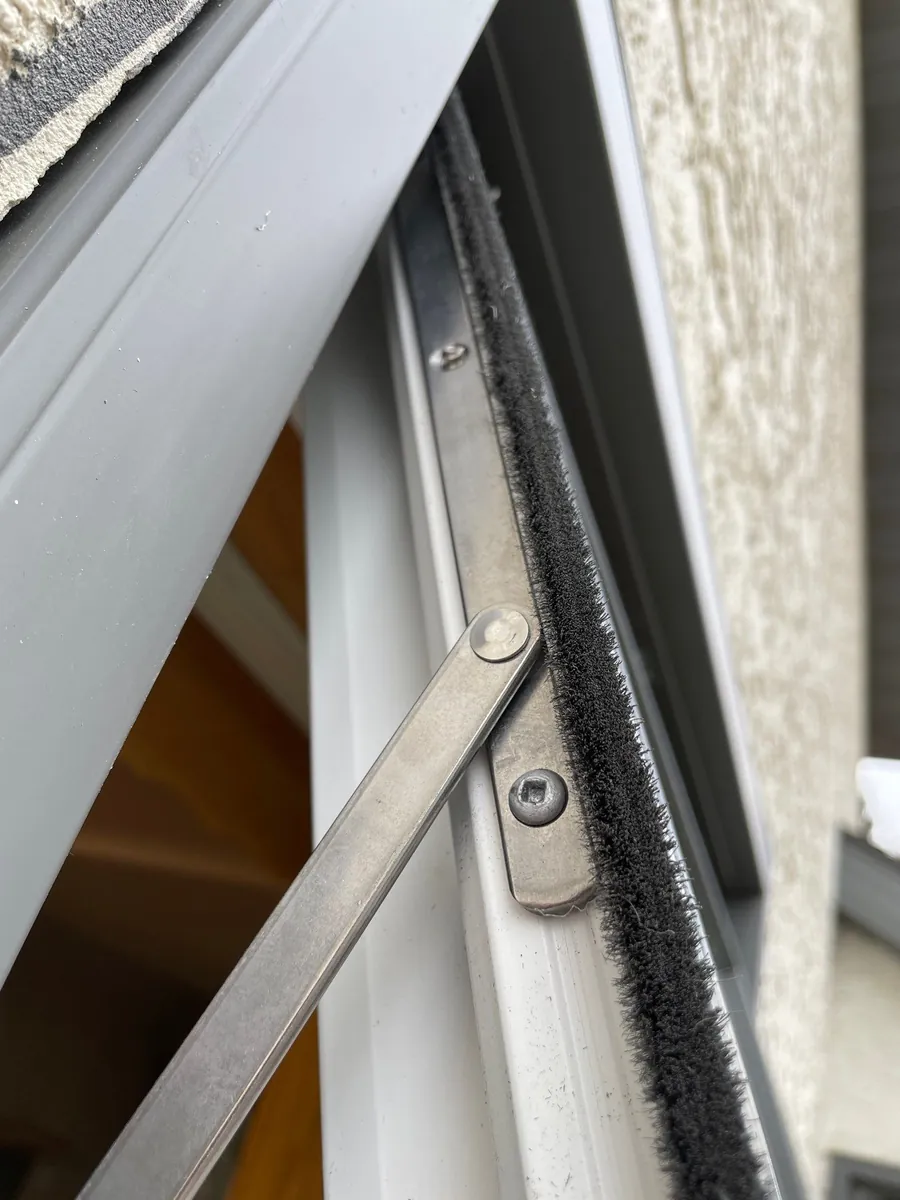
How a window opens matters as much as the glass, because every opening window has a seal — and sound follows air through any gap in it.
- Fixed (picture) windows are the quietest. No moving sash, no operating seal, and the frame can carry heavy glass — up to 5 mm on every pane of a triple.
- Casement and awning windows are close behind. When you lock a casement, the latch pulls the sash tight against rubber compression seals that run around the whole perimeter, usually in several layers. Nothing slides, so nothing wears. With the same glass, you won't hear much difference between a good casement and a fixed window.
- Sliders are the wrong window for a noise job. A slider seals with brush (pile) weatherstrip between two plastic sections, and every time you open it, the brush wears a little more. Think of a toothbrush you've used for five years — eventually it's bare plastic. The seal on a slider gets worse every year you use it. Single- and double-hung windows rely on sliding seals too.
The research agrees on the mechanism. NRC Canada puts a well-weatherstripped opening window 3 to 5 STC points below the same window sealed shut. In one window-industry test, a single-hung window rated STC 26 / OITC 24 as received, and STC 31 / OITC 27 once it was completely sealed — 5 STC points lost to air leakage alone.
The weight limit
Heavier glass is harder on hinges and operators, so how much glass you can use depends on the window type:
- Fixed windows: up to 5 mm per pane in a triple.
- Casements and awnings: 4 mm is the practical maximum, and even then the sash size is limited — a 4 mm casement can't be made as large as a 3 mm one.
- Sliders: heavy glass makes a weak seal harder to operate. One more reason to keep them off the noisy side of the house.
On price, going from 3 mm to 4 mm glass typically adds only about 5–10% to the window. 5 mm glass costs noticeably more.
Installation: How a Good Window Ends Up Noisy
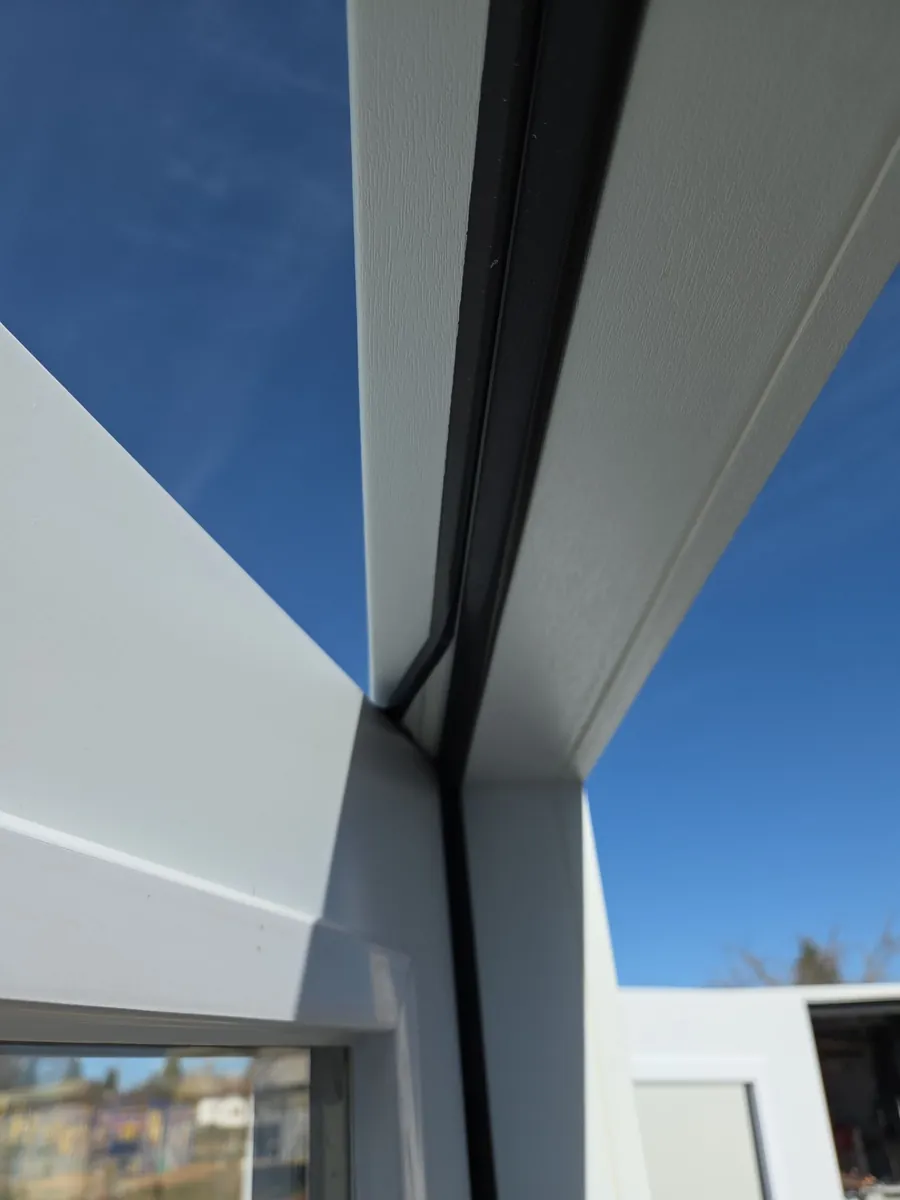
A great acoustic window with a bad install is a noisy window. This is the part no spec sheet covers.
🔨 The noise that wasn't coming through the glass
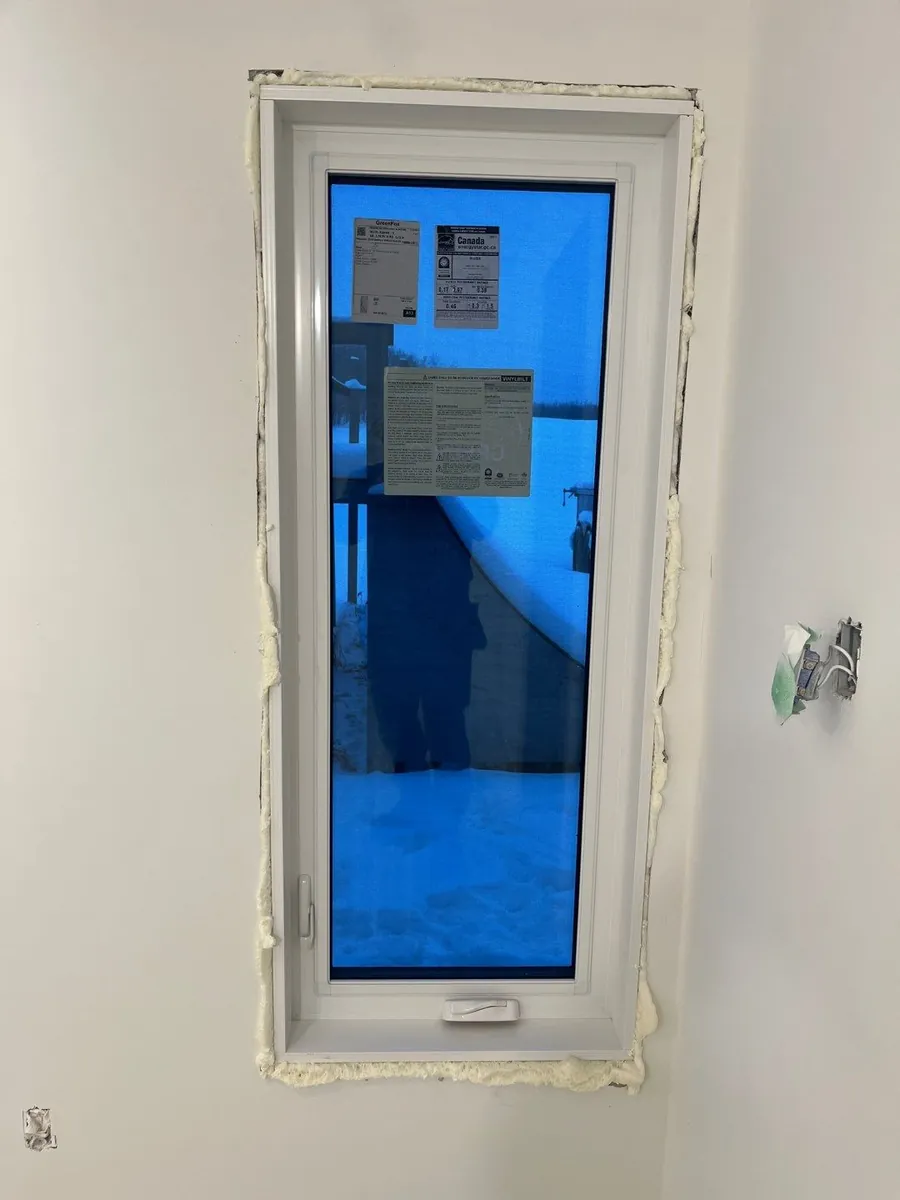
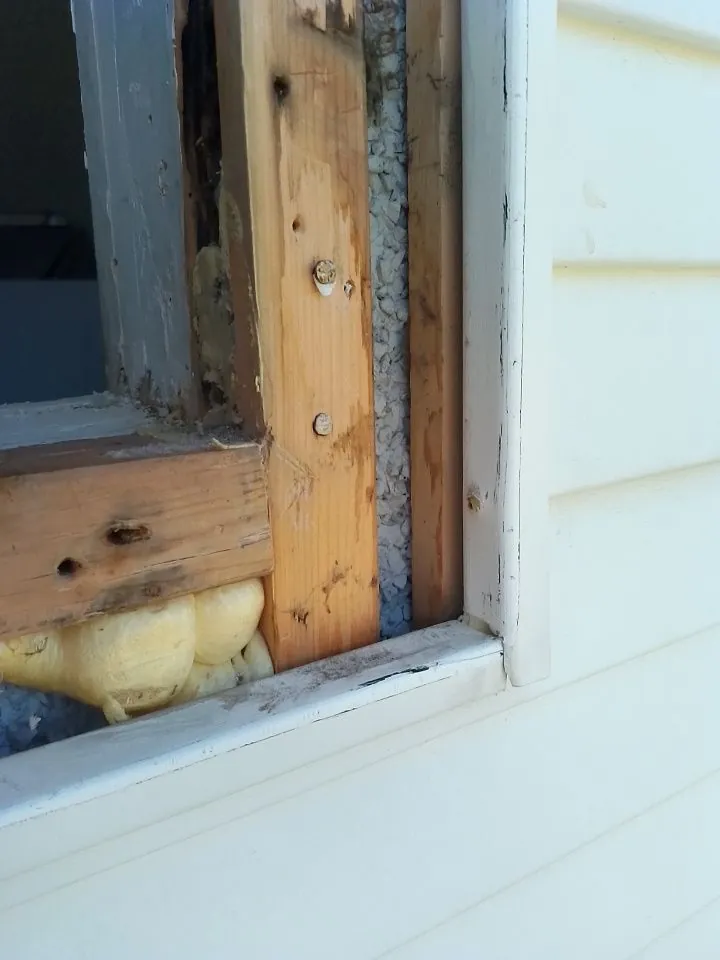
A homeowner called us because his new window "didn't block anything" from the street. He'd installed it himself. The new window was smaller than the old opening, so he'd framed the opening in with a couple of 2x4s — in a 2x4 house, with no foam and no caulking between the new wood and the old. When we opened up the drywall, we could see daylight through the gaps. Cold air and sound were coming through holes in the wall around the window, not through the glass. You can't soundproof a hole.
On a noise-sensitive job, the details that matter are the ones hidden behind the trim:
- Full-perimeter foam with no voids. Low-expansion window-and-door foam cures with smaller, denser cells than high-expansion foam — more sound and heat resistance per inch, and less chance of blowouts that leave hidden air paths. High-expansion foam forms big bubbles that can burst and let air through.
- No shims punched through the foam, and no empty pockets left where a shim sits.
- A continuous air seal on the room side, so air — and sound — can't find a path around the frame.
- Sealed build-outs. If the opening has to be framed smaller, every joint in the new framing needs foam or sealant.
All of it sits behind the casing where nobody will ever see it, which makes it the easiest place for a crew to cut corners. Our full checklist is in What Good Window Installation Actually Looks Like.
Don't Forget the Door
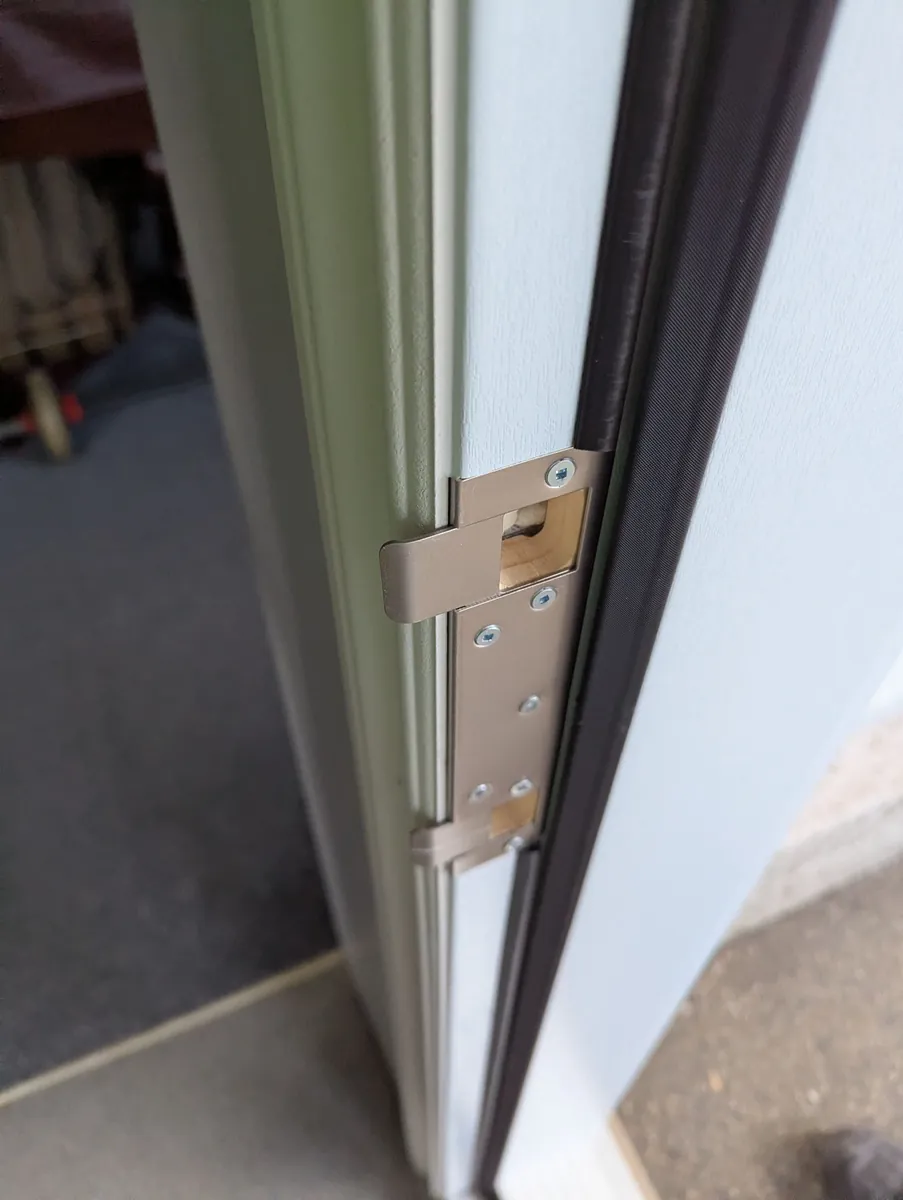
Doors are the other hole in the wall. A standard exterior door is a steel skin over a foam core, with one weatherstrip and a threshold at the bottom. If the room you want quiet has a door on the noisy side, the door can undo everything you spent on the windows.
🚪 A quiet office on a busy road
A homeowner wanted a quiet home office on the main floor and a quiet bedroom upstairs, both facing a road that had become much busier. Upstairs, we used triple-pane casement-and-fixed combination windows with 4 mm glass in the opening casement and 5 mm glass in the fixed section. The main floor got the same recipe. Right beside the office was the back door, also facing the road, so we replaced it with a newer high-performance steel door: a 2-1/2-inch slab instead of the standard 1-3/4 inches, a stiffer skin, and a Z-profile seal system with seals on both the frame and the slab itself. The office and the bedroom ended up quiet, and she was very happy with the result. With the old door still leaking sound into the office, the windows alone wouldn't have done it.
If a door faces the noise, look for a heavier slab, compression weatherstripping on all four sides, a threshold that actually seals, and a proper install. Our door slab framing guide covers what should be behind the frame.
Condos and Windows You Can't Replace
In a Beltline or downtown condo, the board usually controls the exterior windows, and a full replacement may not be on the table. Two options can still help.
Replace just the glass unit
If the frame can take it, a thicker sealed glass unit — heavier glass, or a laminated pane — can go into the existing frame. Expect some improvement, not a transformation: the frame, the seals and the installation all stay the same. Check with the board before ordering anything.
Add an interior secondary pane
An interior insert or secondary glazing panel mounts inside the existing window and leaves a deep air space between the two — something no sealed glass unit can match. That deep space pushes the air-spring resonance below most traffic noise. One insert maker's ASTM E90 lab tests show a window rated STC 29 / OITC 25 on its own reaching STC 43 / OITC 31 with an acoustic insert 1-1/4 inches in front of it, and STC 51 / OITC 36 with the insert 4 inches away. Those are lab results; your walls, seals and ventilation set the real-world ceiling.
Because nothing changes on the outside, this is often the option a condo board will allow — check the bylaws for interior alterations first. Older character homes with original windows worth keeping can use the same approach.
When New Windows Won't Fix Your Noise Problem
We'll tell a homeowner that new windows won't solve the problem when:
- They expect silence. If a freight train shakes the house, you'll hear the train — even if the window were solid wall.
- The noise is overhead. Near the airport, much of the aircraft noise comes through the roof and attic, not the windows. Attic insulation helps and windows help, but neither makes a jet disappear.
- The sound has another way in. Bath and kitchen exhaust vents, dryer vents, mail slots, old doors and leaky attic hatches all connect the inside of the house directly to the outside. Window-industry guidance (AAMA) is blunt about it: "It is of no benefit to install a high OITC rated window in a facade that has flanking problems." Fix the other holes first, or at the same time.
What is realistic is a lot quieter — often quieter than people expect. In our experience, 80 to 90 percent of homeowners are happy with a properly built, properly installed standard triple-pane. Those who pay for the next step, such as 4 mm or 5 mm glass, do get a clearly quieter room — but not twice as quiet, and not silent. Aim for comfortable, not zero.
What It Costs, and Where to Put a Fixed Budget
Prices depend on the manufacturer, the window sizes and the size of the order, so rather than invent per-window numbers, here's the relative picture from Calgary quotes in 2026:
| Upgrade | What it does for noise | Relative cost |
|---|---|---|
| Proper 1-3/8" triple-pane (3/3/3 mm, foam spacer) replacing a builder-grade double | Big improvement, plus much better insulation | The standard choice on most Calgary replacement quotes |
| 3 mm to 4 mm glass in a triple | Clearly quieter | About 5–10% more per window |
| 5 mm glass (fixed windows only) | Quieter again | Noticeably more |
| Laminated double-pane (e.g. 3 mm + laminated 3+3 mm) | Strong on low-frequency noise; insulates like a double | Slightly more than a standard triple |
| Triple-pane with one laminated pane | Best of both | The most expensive option; new to the market |
| Interior acoustic insert (existing window stays) | Strongest retrofit for low-frequency noise | Priced per window — get quotes |
If noise is your number-one goal and the budget is fixed
Make sure every window on the noisy side is a true 1-3/8-inch triple-pane — not 7/8 — with a foam spacer, in a casement or fixed window, never a slider. If the budget stretches, go to 4 mm glass. Then make sure the installation is done right. For most homes, that's more than enough. Spend first on the rooms facing the noise, which are usually the bedrooms.
Who actually offers acoustic glass
In our experience, roughly half of the window lines sold in Calgary offer a real acoustic option — laminated glass, heavier glass, or both. Builder-grade product lines generally don't, because their frames and sashes aren't built to carry heavier, thicker glass units. If your quote is for a builder-grade line and noise matters, you probably need a different product line, not just a different glass option.
What to Ask For on Your Quote
For every window on the noisy side of the house, get these in writing:
- Overall glass unit thickness. For triple-pane, 1-3/8 inches (about 35 mm). A 7/8-inch triple is a triple in name only when it comes to noise.
- The thickness of each pane — 3, 4 or 5 mm — and whether any pane is laminated. If one is, ask for it on the room side.
- The spacer type. A foam warm-edge spacer.
- The operating style. Fixed or casement, not slider.
- A tested acoustic rating, if one exists. Ask for OITC as well as STC, and whether it's for the whole window (from an ASTM E90 test report) or just the glass.
- The installation method. Low-expansion foam around the full perimeter, a sealed interior air barrier, and how any build-out framing will be sealed.
If a salesperson can't tell you the unit thickness or the pane thicknesses, you're not buying a noise upgrade — you're buying a label. More on reading the fine print in How to Read a Window Quote.
FAQ
What STC rating do I need for a house near a busy road?
There's no Calgary requirement for replacement windows, so the target is yours to set. For reference, ordinary double-pane glass tests around STC 31 / OITC 26, a proper 1-3/8-inch triple-pane around STC 34 / OITC 27, and laminated or heavier-glass builds reach the high 30s to low 40s. Window-industry guidance notes that STC 40 or OITC 30 is difficult to reach with a conventional window and a 1-inch glass unit. For traffic, trains or aircraft, compare OITC rather than STC, and compare whole-window test results where you can get them.
Does argon or krypton gas make a window quieter?
No. Gas fill is a thermal feature. Cardinal states that argon filling has no measurable effect on acoustical properties, and in window-industry testing, adding argon left the STC unchanged and moved the OITC by one point. Spend noise money on glass thickness, air space, laminated glass and a sealed installation.
Is triple-pane quieter than double-pane?
Only if the triple-pane unit is thick enough. In Cardinal's acoustic data, three 3 mm panes squeezed into a 7/8-inch unit rate STC 31, the same as an ordinary double-pane. The same three panes in a 1-3/8-inch unit rate STC 34. A laminated double-pane still beats a plain triple on low-frequency traffic noise, so for noise-first rooms the strongest option is a 1-3/8-inch triple with thicker glass or one laminated pane.
Will new windows stop airplane noise in northeast Calgary?
They'll reduce it, not stop it. A lot of aircraft noise comes through the roof and attic, and low-frequency engine noise is the hardest sound for any window to block. Better glass, sealed casement or fixed windows and attic insulation together make a real difference. The acoustic requirements in the Airport Vicinity Protection Area apply to new construction, not to window replacement in existing homes.
Can I make my existing windows quieter without replacing them?
Sometimes. Replace worn weatherstripping and seal gaps around the trim first. If the frame can take it, a thicker or laminated sealed glass unit can be swapped into the existing frame for a modest gain. The biggest retrofit improvement usually comes from an interior secondary pane or acoustic insert with a deep air space, which is often the only option in a condo where the board controls the exterior windows.
The Bottom Line for Calgary Homeowners
Windows can make a noisy Calgary house much quieter — not silent — as long as the money goes to the right places:
- Glass thickness, air space and laminated glass stop sound. Pane count by itself doesn't, and gas fill doesn't at all.
- A 7/8-inch triple is marketing. A 1-3/8-inch triple is the sensible default, and 4 mm glass is the most affordable step up from there.
- For traffic, trains and aircraft, compare OITC — and whole-window numbers, not glass-only numbers.
- Casement and fixed windows on the noisy side. Never sliders.
- The install, the doors and the vents set the ceiling. You can't soundproof a hole.
Have a noise problem and a quote in hand?
Send us the glass details — unit thickness, pane thicknesses, spacer and window styles — and tell us what you're hearing. We'll tell you plainly whether that quote will make a difference, and where the money would do more.
Ask a QuestionWhere the numbers in this article come from
- Cardinal Glass Industries, Technical Service Bulletin IG09, Glass Acoustical Performance — double- and triple-pane STC/OITC tables, argon and window-assembly notes.
- Guardian Glass, Expert Series: Glass Acoustic Performance — laminated, acoustic-PVB and triple-pane comparisons.
- Viracon, Acoustic Performance Data Tables — asymmetric, laminated and triple-pane STC/OITC.
- National Research Council Canada, Canadian Building Digest 240 on sound transmission through windows — triple vs double glazing, air-space resonance, lamination at winter temperatures, opening vs sealed windows.
- AAMA TIR-A1, Sound Control for Fenestration Products — perception of level changes, sealed vs as-received tests, spacer and argon tests, flanking.
- ASTM E90, E413 (STC) and E1332 (OITC) — test and rating standards.
- City of Calgary, Noise Barrier Program and Airport Vicinity Protection Area.
- Interior-insert figures: a manufacturer's published ASTM E90 test reports for an acoustic insert over a single-pane tempered window.
Related Articles
Triple-Pane vs Double-Pane
When the third pane pays for itself in Calgary, and when it doesn't.
What Good Installation Looks Like
Foam, sealing and the details behind the trim that decide how a window performs.
How to Read a Window Quote
What every line on a quote means, and the red flags to push back on.
How to Choose Windows for Calgary
The full selection guide for Calgary's climate: glass, frames, coatings and budget.