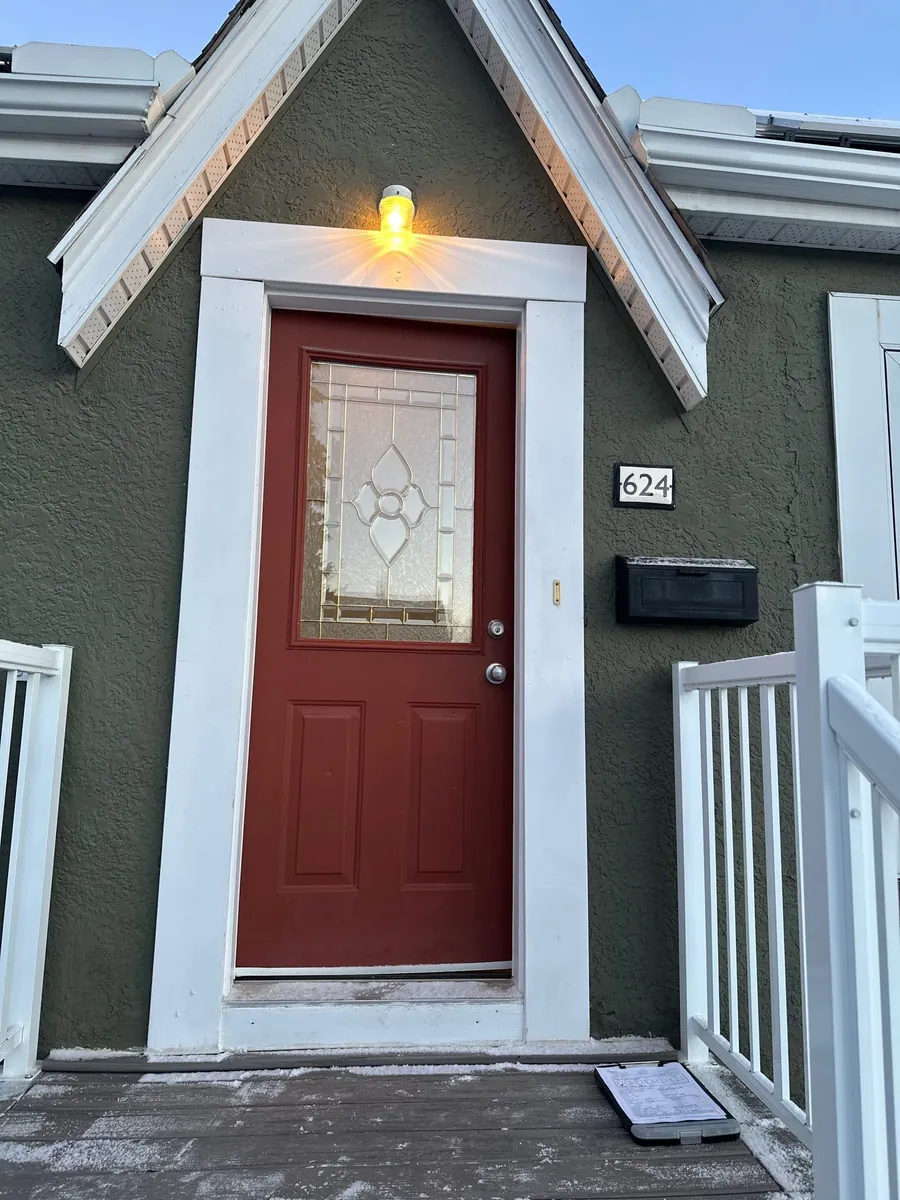
"Double pane versus triple, is it worth the huge cost difference?" We kept running into versions of that question when we went through Calgary-area homeowner posts on Facebook. Its cousin showed up during the January 2024 cold snap: a photo of ice on the inside of a door's glass, with the owner pointing out, "it's double pane glass."
Here's the installer's answer. On a door, the glass is the third thing that matters. First comes function: how the door opens, closes and seals, which comes down to alignment and hinges. Second is design, because the glass is what makes a door look good. Third is how efficient the glass is. Most of the door problems people blame on the glass, frost included, start with the first one.
This guide covers what double and triple glass actually do in an entry, back, garden or French door, when the upgrade is worth it, why door glass frosts when your windows don't, when to replace just the glass, and what to ask before you buy.
The short answer
- Triple in a door isn't triple in a window. Door glass units are usually 1 inch thick whether they're double or triple, so the third pane splits the same space instead of adding insulation. Most of the gain comes from the second Low-E coating.
- The price gap is small. Triple usually adds about $200–$300 to a door, maybe $500 on a big glass. On a good door, that's not the decision that makes or breaks the job.
- Buy triple for big glass, a humid house or a frost history. Full-lite, garden and French doors, and homes that already fight condensation.
- A good double beats a cheap triple. Look at the Low-E, the spacer and the frame around the glass, not just the pane count.
- Frost is mostly humidity, air movement and air leaks. Keep humidity in Health Canada's 30–50% range, toward the low end in a cold snap, and get the door aligned before you blame the glass.
- Ask about the hinges. A door with thousands of dollars of glass and paint, hung on light hinges, will sag and leak whether the glass is double or triple.
| Your door | Our pick | Why |
|---|---|---|
| Small top lite or quarter glass | Good double | Too little glass for triple to make a difference |
| Half-lite door, dry entry with good air movement | Good double | Triple adds a little comfort and not much else |
| Full-lite entry door | Triple | Lots of glass, so the glass decides how warm the door feels |
| Garden door or French door | Triple | Mostly glass, so the glass decides the rating |
| Tall 8-foot (96") door with long glass | Triple | The most glass of all |
| Humid house, poor ventilation or a frost history | Triple, and fix the humidity | Warmer glass buys margin, but it won't stop frost on its own |
| Cheap door that needs adjusting every season | Neither: fix or replace the door | No glass can fix a door that doesn't seal |
Why Triple Glass in a Door Isn't Like Triple in a Window
In a window, going triple means a thicker glass unit. A typical double-pane window unit is about 7/8 inch thick, and a proper triple is about 1-3/8 inches. The extra width gives the third pane its own full air space, and done properly that's roughly double the insulation of the glass. It's a big jump, and it's why we put most Calgary customers in triple-pane windows (our triple vs double pane windows guide has the numbers).
Door glass doesn't work that way. The glass in a steel or fibreglass door slab sits in a frame sized for the slab, and the sealed glass unit is usually 1 inch thick whether it's double or triple. Same width. The third pane doesn't add an air space. It splits the one that was there into two narrower ones, and narrower spaces insulate less each, so the extra pane on its own adds little. What triple door glass really buys you is room for a second Low-E coating. With three panes, you can have two coatings instead of one, and the coatings make more difference than the pane count.
The glass is a small part of the door's rating
A door is mostly slab, and the slab is insulated: a steel or fibreglass skin over a foam core. Glass is the weak spot, and the more of it there is, the more it decides how the whole door performs. Kohltech, a Canadian door and window maker, publishes whole-door ratings that show this clearly:
| Glass in the door | Quarter glass | Half glass |
|---|---|---|
| Double, Low-E and argon | 1.02 | 1.14 |
| Triple, Low-E and argon | 0.97 | 1.08 |
| Triple, two Low-E coatings and argon | 0.91 | 0.97 |
| Same door, no glass | 0.74 | |
Whole-door U-values in W/m²K (lower is better) for Kohltech's steel entry door, from its published Canadian ratings. ENERGY STAR in Canada requires 1.22 or lower. Ratings vary by maker and model, so check the exact door you're quoted.
On a half-glass door, going from double to an ordinary triple moves the whole door from 1.14 to 1.08, about 5%. Going to the best triple, with two coatings, gets it to 0.97, about 15%. Notice that the big step comes with the second coating, which is exactly the point above. Kohltech's fibreglass door shows the same pattern. And on Kohltech's list of models that qualified for the federal home-retrofit grant, the full-glass doors appear only with triple glass. That matches what we see: the bigger the glass, the more the glass decides the rating, and the more triple earns its place.
What that means on your gas bill
Let's put a number on it. Take a standard 36-by-80-inch door through a typical Calgary heating season. Upgrading the half-glass steel door above from double to the best triple saves roughly 40 kWh of heat a year, which is about 0.15 GJ of natural gas. Even if you pay $10 a gigajoule all-in, that's about a dollar and a half a year. Even the gap between a solid door and a full-glass door works out to only a few dollars of gas a year.
Our estimate: U-value difference × door area (1.86 m²) × Calgary's 5,000 heating degree-days × 24 hours, burned in a 95% efficient furnace. It ignores sun and air leakage, so treat it as the right order of magnitude, not a promise.
That's why we tell people not to choose door glass for the energy bill. You choose it for comfort, for frost and condensation, and for how the door looks. And a door that doesn't seal will leak many times more heat through the gaps than any glass upgrade saves.
When Triple Glass Is Worth It, and When It Isn't
Triple usually adds about $200–$300 to the price of a door, maybe $500 on a very large glass. That's real money, but a good door can cost $5,000 to $10,000 today, so it won't rob your bank either way. The real question isn't "can I afford triple?" It's "will triple do anything for this door?"
Triple makes sense when
- The glass is big. A full-lite door, a garden door or a French door is mostly glass, so the glass decides how warm the door feels and how it rates. Tall doors are the strongest case: an 8-foot door with a 22-by-80-inch glass has a lot of square footage for cold to come through.
- Your house runs humid with poor ventilation. If you already see condensation or ice on glass in winter, warmer glass gives you margin. Fix the humidity too; more on that below.
- The door area runs cold and damp. Frost on the door glass in past winters, or hinges that rust, are signs that the door could use the extra margin.
- The location is brutally cold. In places like Saskatoon or Prince Albert, where winter nights can drop into the minus 40s, the extra $200–$300 is easy to justify on any door.
A good double is fine when
- The glass is small. A small top lite or a quarter glass is too little glass for triple to matter.
- The door gets lots of air movement. Air that moves past the door is usually dry, and in our experience double vs triple makes no noticeable difference there.
- Your humidity is under control and the door seals well. Then neither option will give you trouble.
One more honest observation: about a month after the install, lots of people can't remember whether they bought double or triple door glass. They spend a lot of time choosing, because with windows it really is a big question. With doors, unless there's a humidity or ventilation problem at the door, they never think about it again.
A good double beats a cheap triple
Pane count is one line on a spec sheet. What makes door glass good is everything around it:
- Tempered glass, about 4 mm thick.
- Low-E coating: one coating on a double, two on a triple. A triple with no Low-E is mostly a heavier double.
- Argon gas between the panes.
- A warm-edge spacer around the edge instead of metal. Metal conducts cold, and the edge is where door glass frosts first.
- A good lite frame. That's the plastic frame that holds the glass in the slab. Cheap frames get damaged by UV, bend and go crooked, and the glass seals fail. In practice, the frame matters more than the pane count.
- Grilles that last. Cheap grilles between the glass can fade, or even warp, in strong sun.
The published ratings back this up. On Kohltech's quarter-glass steel door, a triple with plain clear glass rates exactly the same as a double with Low-E and argon (1.02). And Pella's entry door data goes further: its triple-glazed decorative full-lite, which is air-filled, rates worse (U 0.30 in US units) than its double Low-E argon full-lite (U 0.25). A cheap triple can be worse than a good double.
The good news: most door companies selling in Calgary today put good-quality double or triple glass in their doors. Be careful with suspiciously cheap doors, though. Some use no-name imported glass units styled to look like the Canadian brands, and that's where quality slips. The glass is rarely the weak point of a door. The door around it often is.
Full Glass, Half Glass or No Glass?
If heat loss were the only thing that mattered, every door would be solid. Glass is a conductor, not an insulator. Good glass or bad glass, it's still glass, and the bigger it is, the more heat goes out in winter and comes in in summer. That's just physics. Here's how much the glass size changes one US steel door maker's ratings:
| Steel door | U-value (US units) | U-value (W/m²K) | Roughly |
|---|---|---|---|
| No glass | 0.16 | 0.91 | R-6 |
| Half lite | 0.22 | 1.25 | R-4.5 |
| Three-quarter lite | 0.25 | 1.42 | R-4 |
| Full lite | 0.27–0.32 | 1.53–1.82 | R-3 to R-3.7 |
| Full lite with blinds between the glass | 0.29–0.35 | 1.65–1.99 | R-3 |
NFRC-tested whole-door ratings from a US steel door maker's energy sheet. Canadian-rated doors differ, but the pattern is the same: more glass, more heat loss.
But heat isn't the whole picture:
- Glass protects the door. Steel skins dent and scratch easily. A big glass is a big area that won't.
- Glass is the design. It's what makes a door look like more than a slab. A full or large glass looks rich. A small piece of glass at the top can look like someone was trying to save money.
- Glass sells. People who buy and sell used door slabs on Kijiji and Facebook Marketplace know it: a slab with a big, nice glass sells in seconds, and buyers pay more for it. Small glass or no glass, and it sits.
So yes: bigger glass, more heat loss. But as the gas math above shows, the difference is a few dollars a year. If you love a full-glass door, buy the full-glass door, and put triple in it.
Afraid the big glass will break?
Don't be. Door glass is tempered: about four times stronger than regular glass of the same thickness. It shrugs off what a door takes every day: kids, boots, a slammed door, a hockey bag swung too close. Breaking it takes a deliberate, hard hit, usually with a pointed tool, which is exactly what a burglar brings. And if it does break, tempered glass crumbles into small, blunt pieces instead of long shards. There's more on break-ins in the safety section below.
Why Door Glass Frosts, and What Actually Fixes It
Frost and condensation are the biggest door-glass complaint in Calgary, and the one most often blamed on the wrong thing. Three things decide whether your door glass sweats or frosts: how cold it is outside, how much moisture is in your indoor air, and how well that air moves around the door. The glass itself is only part of the story.
Any surface in your house that's colder than the dew point of your indoor air gets wet. If that surface is also below 0 °C, the water shows up as frost. At a room temperature of 21 °C:
| Indoor humidity | Surfaces get wet below about |
|---|---|
| 30% | 3 °C |
| 40% | 7 °C |
| 50% | 10 °C |
Dew point of 21 °C indoor air at each humidity (standard psychrometric values). Below 0 °C, the moisture freezes as frost.
The middle of a decent sealed glass unit stays above those temperatures most of the winter. The edges don't. And on a door, the edges are where the cold is.
Why the door frosts when the windows don't
Door glass usually has less insulation than your windows, and it sits in a slab that has edges, a threshold and weatherstripping, all of which can leak cold air. In most steel and fibreglass doors, the glass is clamped between two plastic frames screwed through the slab, called a "lip-lite" frame. Therma-Tru, one of the biggest door makers, explains that there's an air space of about a quarter inch between the glass and the slab behind that frame, and that frost there in extreme cold is "not a defect." Its recommended fix is lower indoor humidity.
The warranties agree. Therma-Tru's excludes condensation and frost caused by humidity inside the house, and Masonite's excludes condensation on the inside of the door or glass. Fog between the panes is different: that's a failed seal, and it's covered. More on that below.
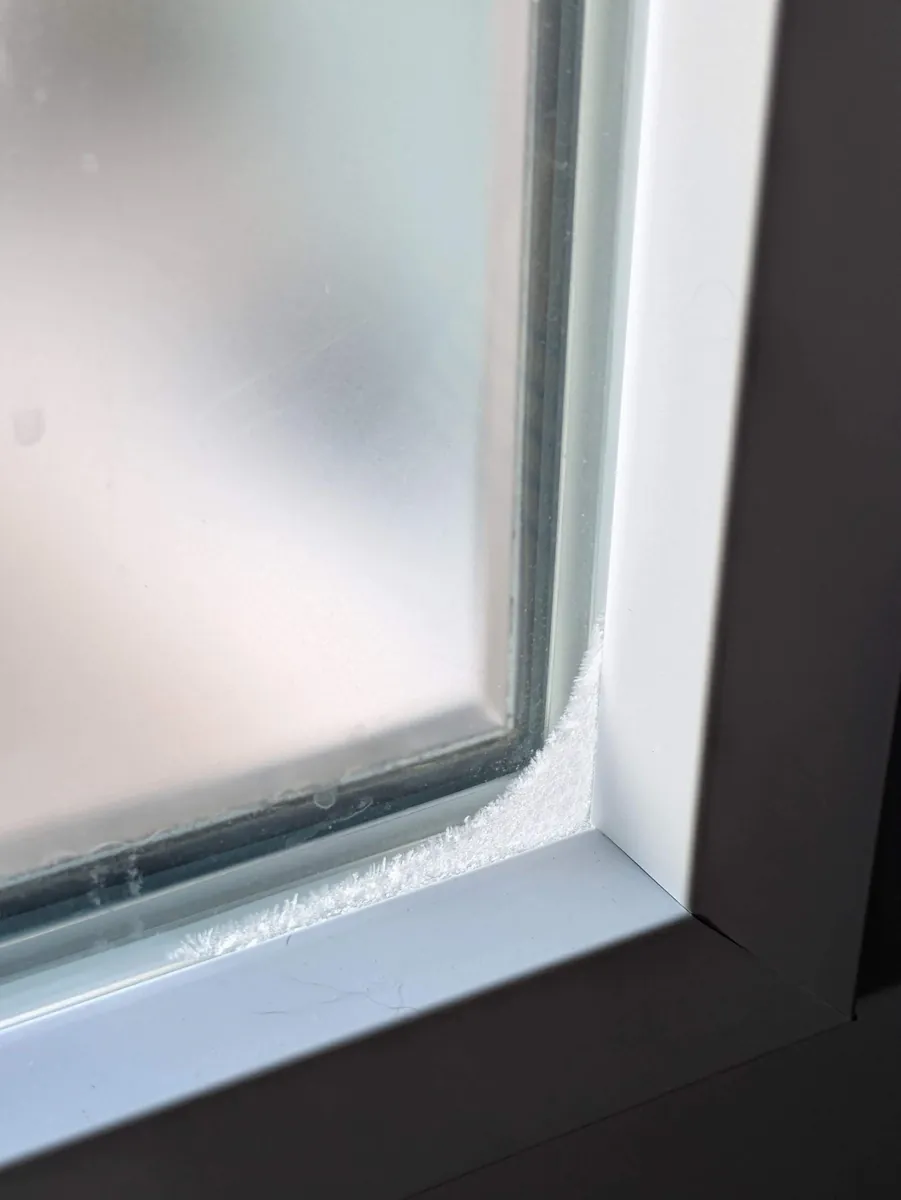
Frost around the edge of the glass
Frost around the edge of the glass but not the middle is very common, and the usual cause is a metal spacer. The spacer is the strip that holds the panes apart around the perimeter of the sealed unit, and metal conducts cold far better than the glass and gas in the middle. How bad it gets depends on three things: the temperature outside, the humidity inside and the air movement at the door. Warm-edge spacers help. Novatech, a large Canadian door-glass maker, uses a warm-edge spacer in its door glass and says it reduces condensation around the edge of the glass in winter. Our window spacers guide explains the types.
Frost at the bottom of the door: bad door or bad install?
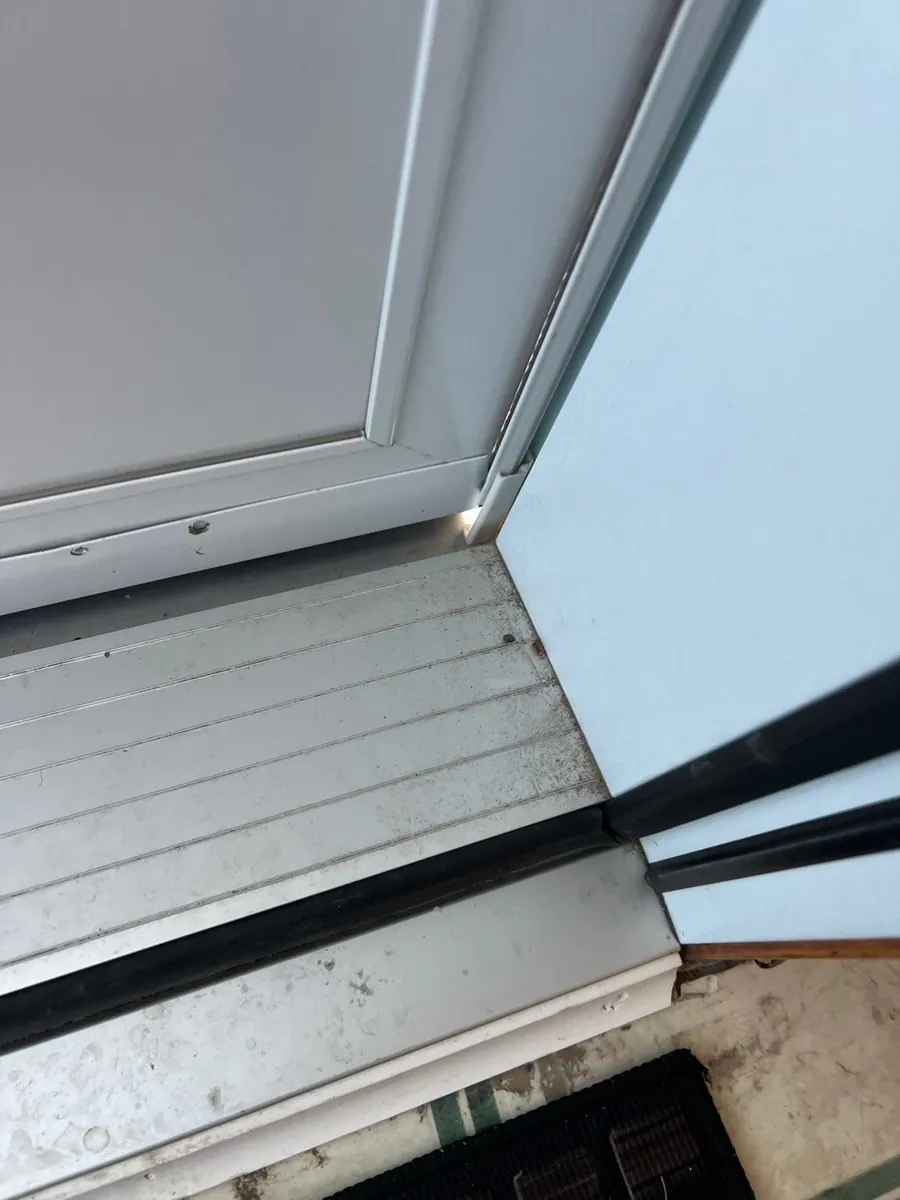
Frost or ice at the bottom of the door, on the trim or along the edge of the slab, almost always means an air leak. Cold air gets in, chills the surface, and the moisture in your house does the rest. It can be a poor-quality door or a poor install. Either way, in our experience the root cause is nearly always alignment, much more often than the seal itself. When a door sits out of square in its frame, the weatherstrip doesn't press evenly all the way around, and you get a gap you can't see but the frost can.
🔧 What people really need is alignment
Homeowners almost never ask for it by name, but alignment is what makes a door work. When we set a door properly, square in its frame with the weatherstrip pressed evenly on every side, people are happy, whatever glass, slab or paint they picked. When the alignment is off, nothing else they paid for makes them happy. And if you can see daylight around the slab or feel air coming in, talking about double vs triple glass is pointless. Fix the door first.
Before you blame the glass, check the door. Therma-Tru's own frost checklist covers most of it:
- The sweep at the bottom of the slab: does it touch the threshold all the way across? Sweeps stiffen in the cold.
- The weatherstrip: does it press evenly on all sides, or is there a corner where it barely touches?
- The corner pads where the weatherstrip meets the threshold: are they there, and sealed?
- The foam between the door frame and the house framing: is the gap actually filled and sealed?
- The exterior caulking: is it continuous?
- The gaps around the slab: are they even? If not, the door needs adjusting. Our door framing guide shows what a square, properly shimmed door looks like.
Will triple glass stop the frost?
Not 100%, and nobody can honestly guarantee it, because it depends on your humidity and where the door is. But a good triple, meaning one with a warm-edge spacer and a good lite frame, in a properly installed door, will keep frost off the glass in most homes at normal humidity. A triple in a frame that leaks air, or in a door that doesn't seal, will still frost around the glass.
What humidity to keep in a Calgary winter
Don't dry your house out to protect bad doors and windows. Dry air has real costs: dust, static, itchy skin, cracked wood floors and furniture. Health Canada recommends keeping indoor humidity between 30% and 50%, and that's the range we recommend too.
In a Calgary winter, the cold snaps are when the top of that range causes trouble. When it's −20 °C and colder, run toward the low end. ATCO's guide for Alberta homes suggests staying closer to 30–35% in winter to prevent condensation on windows, and our window condensation guide explains why risk climbs fast above 40%. If you'd rather keep your house at the comfortable end of the range, the better answer is doors and windows good enough to handle it, not a drier house.
Two more things help: keep air moving at the door, and run your bathroom and kitchen fans. Health Canada notes that heavy curtains and closed blinds trap cold, damp air against glass, and a curtain pulled over a door's glass all night does exactly that.
Myth: frost on a new door is a warranty defect
Usually it isn't. Door makers treat condensation and frost from indoor humidity as a house condition, not a door defect, and their warranties say so. What is a defect: moisture or fog between the panes of the sealed glass, a lite frame that's cracked or warped, or a door that was built or installed out of square and won't seal.
❄️ "It's double pane glass!"
During the January 2024 cold snap, when temperatures across much of Alberta dropped into the minus 30s and 40s, a post from a Calgary home showed ice on the inside of a door's glass. The owner pointed out that it was double pane, as if that should have prevented it. Our take: at those temperatures, with ordinary indoor humidity, ice is no surprise on a lower-quality door with a cold glass edge or a seal that doesn't close. Double pane wasn't the problem, and triple on its own wouldn't have been the fix.
Foggy or Cracked Door Glass: Replace the Glass or the Door?
Fog between the panes means the seal has failed
If you see moisture or a milky haze between the panes, the seal around the glass unit has failed, every time. A sealed unit is filled with dry gas, usually argon, and has a drying agent in the spacer to absorb any trace of moisture. Once moisture shows up between the panes, the seal has let damp air in and the drying agent can't keep up. It can't be cleaned out from the outside. The whole sealed unit has to be replaced. Seal failure is the kind of glass failure warranties do cover, so check your door's glass warranty before you pay for it yourself.
Yes, you can replace just the glass
Most steel and fibreglass doors take a standard glass insert: the sealed glass unit clamped between two frames that screw together through the slab, with plugs covering the screws. Sizes are named by the glass:
| Insert (glass size) | Typical door | Frame size |
|---|---|---|
| 22 × 36 in | Half lite | About 24 × 38 in |
| 22 × 48 in | Three-quarter lite | About 24 × 50 in |
| 22 × 64 in | Full lite | About 24 × 66 in |
Standard sizes for 1-3/4-inch steel and fibreglass door slabs. Measure your glass and frame before ordering; older and specialty doors vary.
Most of these sealed units are 1 inch thick, double or triple. That's also why you can usually upgrade from double to triple by replacing the glass unit, as long as the slab and the hinges can carry the extra weight. Whether that's worth doing is the question the rest of this guide answers.
At Canadian home centres, the insert alone runs from about $250 for a basic half-lite grille unit to about $400 for a clear Low-E full lite, $650 or so for decorative glass, and about $740 for a full lite with blinds between the glass (Home Depot Canada listings, fall 2026).
What it costs to have it done in Calgary
This is where expectations and reality part ways. In a Calgary Facebook group this summer, a homeowner asked what a fair price would be to replace the large glass panel in an exterior door while keeping the door and its hardware. The answers ranged from about $500 at a glass shop, to a $100 used insert off Marketplace, to "45 minutes with a YouTube video."
Our experience: you can find the glass for $500, but very few people will install it for that. Expect a door glass replacement in Calgary to cost about $1,000 at the minimum with labour, and usually $1,000 to $2,000, depending on the size, the design and whether it has blinds. It can also be hard to find someone to do it at all. Lots of companies will sell you a new door. Far fewer will agree to swap the glass in your old one.
The reason is risk. Every insert frame has its own snap-and-screw system, and older frames get brittle. Taking one apart without breaking it, and putting it back together so it seals, takes skill. Crack the frame and the small job just got bigger.
Can I do it myself?
Door-glass makers sell DIY kits and say a same-size swap takes about an hour with two people. Our honest answer: only if you're a genuinely skilled handyman, or it's a door you don't much care about. The frames crack easily, the sealant has to be done right or the frame leaks air and water, and a full-lite unit is heavy and awkward. A used insert from Marketplace adds its own problems. It often comes with a broken frame, missing snaps or screws and a seal of unknown age, and the result tends to leak air around the glass.
One pane cracked on a cold night
A crack that runs across one pane on a very cold night is usually thermal stress. The glass gets much colder at the edge, where the frame holds it, than in the middle, or a dark blind or curtain traps heat against the inside pane while the outside is frozen. The difference in temperature across the pane is what cracks it, and chips along the edge from installation make it more likely. Tempered glass handles this far better than regular glass, and it doesn't crack in a line: when it fails, the whole pane breaks at once. So a single crack running across a pane usually points to an older door with ordinary glass.
Either way, you can't replace one pane of a sealed unit. The panes are built and sealed together, so the whole unit gets replaced. The only exception is an old single-pane door, like a barn or shed door, where the glass is just a sheet of glass.
Don't put expensive glass in a cheap door
Here's the rule we use. A good glass unit costs real money: $1,000 to $2,000 installed. If it's going into a $300 door that drifts out of alignment every six months and needs adjusting every winter and summer, that money is wasted. You'll have beautiful glass in a door that still leaks. Replace the glass when the door itself is good: solid, square, holding its alignment, and hung on hinges that can carry the weight. If it isn't, put the money toward a better door.
Weight, Hinges and Sag: The Question Nobody Asks
Triple glass is heavier. A 22-by-64-inch full lite is about 10 square feet of glass, so with 3 to 4 mm panes the third pane adds roughly 16 to 20 lb. Andersen says triple glass can make a door up to about one and a half times as heavy.
Does that make the door sag? A bad door sags anyway. It sags and loses alignment with no glass, with double glass, with anything; the extra weight just gets it there faster. A good door on good hinges carries triple glass without anyone noticing.
"What's your hinge?"
Here's what almost nobody checks. Go and look at your exterior door hinges. On most doors in Canada, they're the same kind of light residential hinge as on your bathroom door, the kind that costs about $3 at a home centre. Now think about what's hanging on them: an insulated slab, maybe $2,000–$3,000 of glass and another $2,000–$3,000 of paint and finish, swinging thousands of times a year through Calgary's freezes and thaws.
Putting all of that on a $3 hinge is madness. Commercial hinges cost about $30 each and up. They're heavier metal, they can be fine-tuned without taking the door down, they don't let anyone pop the pins from outside, and they hold a door's alignment for years. If a door comes with light hinges, it's a contractor-grade door, whatever the brochure says: the kind you can buy for about $350 at a contractor supply shop.
When you shop, ask for:
- Commercial-grade or ball-bearing hinges. Always, with or without glass, double or triple.
- Long screws through the hinges into the house framing, not just into the door jamb. The short factory screws are a sag point and a kick-in point. Our door framing guide shows why.
- A strong slab and frame: an LVL or engineered-wood frame inside the slab, and a solid jamb.
Heavy doors and multi-point locks
With good hinges and a strong door, you don't feel the weight of the glass at all. The trouble starts when a heavy slab hangs on weak hinges. It drops at the latch side, goes slightly crooked, and a multi-point lock, which engages at the top, middle and bottom at the same time, starts to bind or won't latch. That isn't the glass's fault. It's the hinges and the frame, and the fix is the same: hinges and a slab that hold their shape.
Why companies sell triple windows but only double doors
Because in a door, double or triple isn't the point, and the industry knows it. Windows get sold on insulation. Doors get sold on looks: the glass design, the colour, "lots of foam in the slab." Honestly, most doors on the market are poor. The windows we see in Canada are mostly good, but doors are a different story. So instead of asking about pane count, ask the questions that tell you whether the door will work:
- What is the hinge?
- Is there a gap at the bottom corners, where the weatherstrip meets the threshold?
- Is it a double seal?
- What's the threshold, and does it adjust?
Decorative Glass, Privacy Glass and Blinds Between the Glass
Is decorative "triple-pane" glass warmer?
A lot of decorative door glass is sold as triple-pane, and here's why. The decorative pane, with its patterns, bevels and metal caming, sits in the middle, sealed between two clear panes that protect it. ODL, one of the largest door-glass makers, describes it exactly that way, and Therma-Tru builds all of its privacy and textured door glass as triple.
So is it warmer? A little, the way any triple is: some extra heat resistance, not a huge amount. But check what's inside. A decorative triple with no Low-E coating and plain air between the panes can rate worse than a good double; that's the Pella example above. Ask whether your decorative glass has Low-E and argon. Some makers offer it; many decorative units don't have it.
Privacy glass or frosted film?
Factory privacy glass wins, and it isn't close. The pattern is part of the sealed unit, it can't be scratched off, you can wash and scrub it like any glass, and it looks like it belongs on a front door. We can't think of a downside. Frosted film is cheap, and that's its one big advantage. It scratches, it's hard to apply without bubbles and visible edges, and it rarely looks right on a front door.
That said, if your door is otherwise good and you just want privacy without replacing the glass, film is a perfectly good idea. One caution: on sealed glass, check with the door maker first. Film, especially a dark one, makes the glass absorb more heat, which can raise the risk of a stress crack, and it may affect the glass warranty. Our guide to tempered, laminated and obscure glass compares the privacy patterns.
Can people see through wavy glass at night?
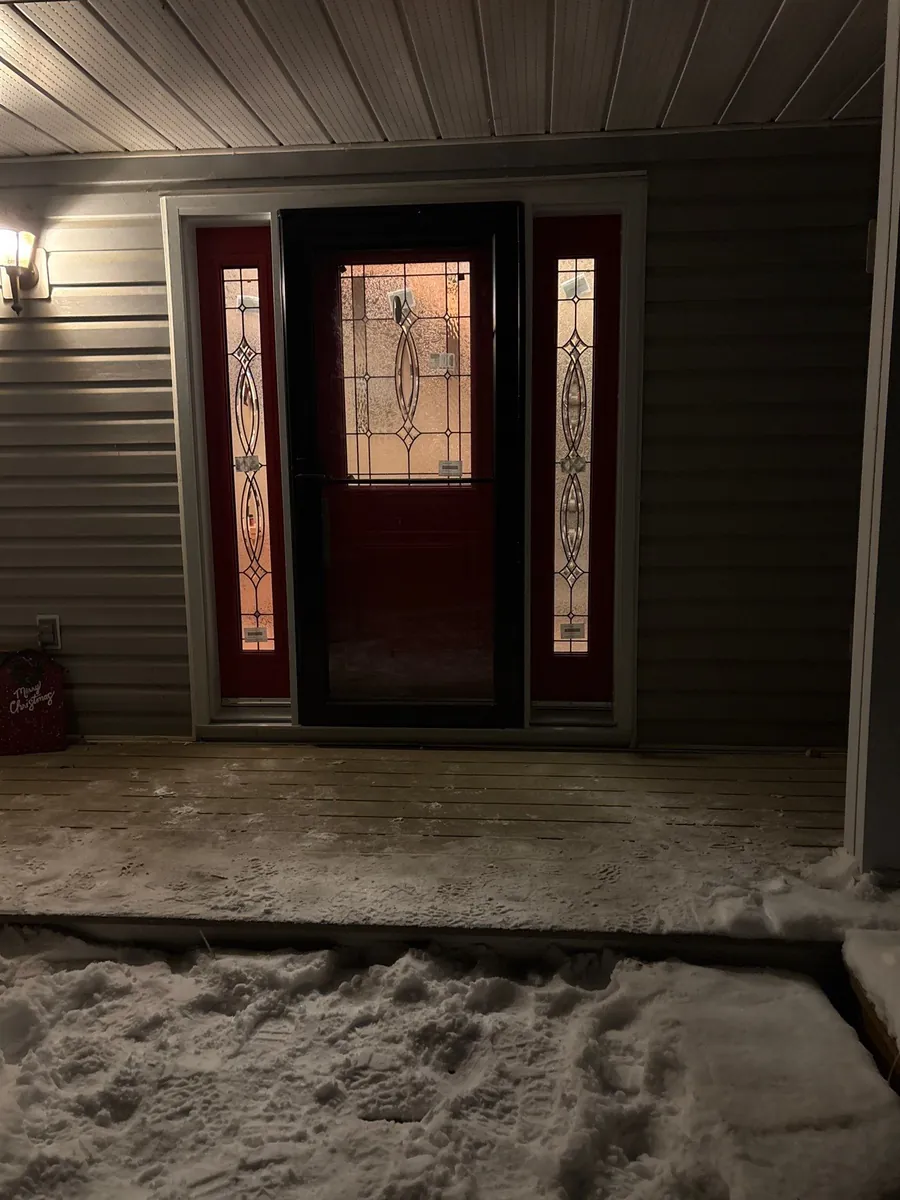
Yes, to a degree. Every textured glass shows something. The question is how much: whether someone outside sees a shape, just light and movement, or colours, and how close to the glass you have to stand before they can. At night, with the lights on inside, every pattern shows more. Door-glass makers rate their designs for privacy (ODL uses levels from low to maximum; Novatech uses a 1-to-5 scale), so choose the level you need, and look at a real sample with a light behind it before you order.
Blinds between the glass
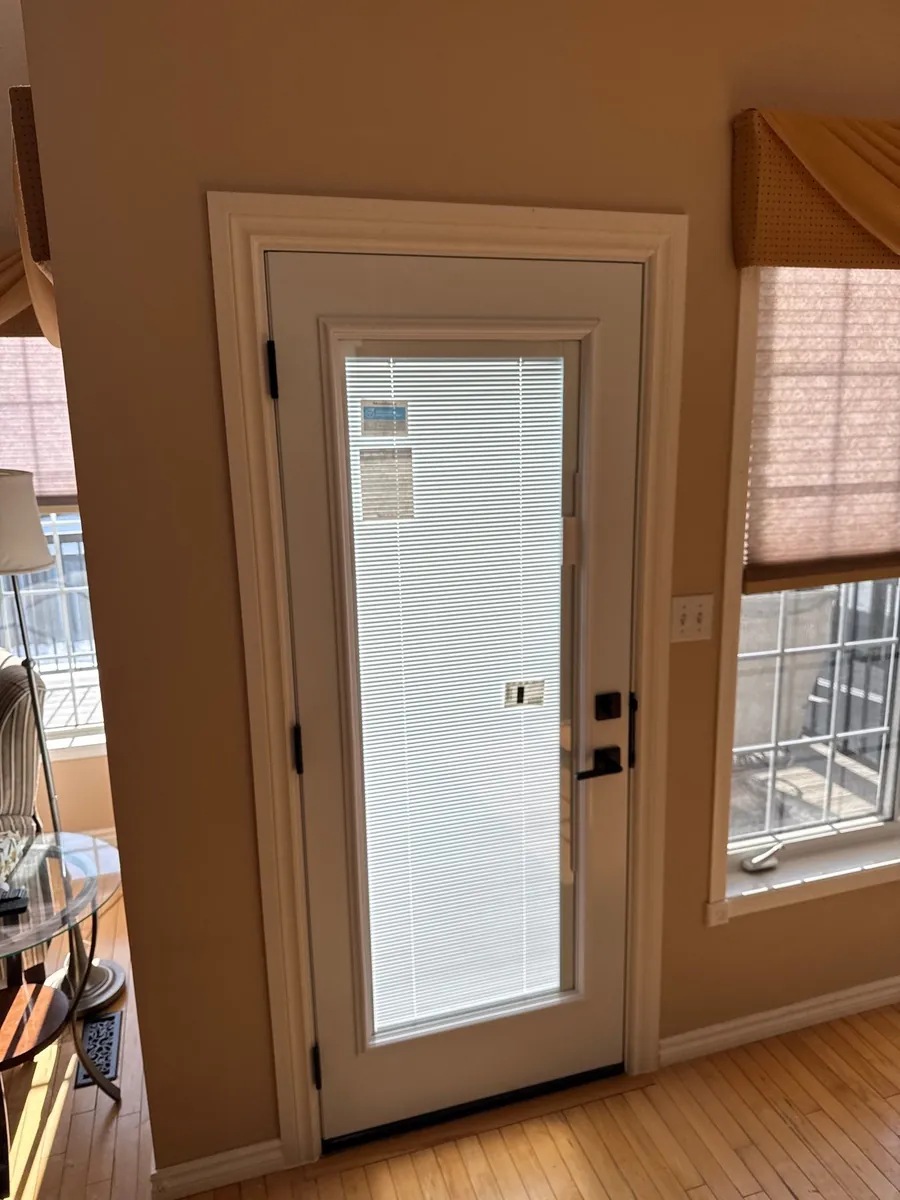
When blinds between the glass work, they're great: no dusting, no cords, nothing to break off. When they stop working, it's about the most annoying thing a door can do, because the blind is sealed inside the glass unit. You can't get at it to fix it. A stuck blind means a warranty claim, a new insert or a new door.
In our experience the difference is simple: cheap blinds-between-glass units break, and good ones keep working. If you want blinds in your door, this is the place to overpay. ODL, for example, backs its enclosed blinds with a 20-year warranty on the mechanism and the seal. Ask what warranty your door's blinds carry, and who honours it.
A good-quality blinds unit can cost $1,500 or more, so the same rule applies as with any glass swap: don't put a $1,500 blinds unit into a $300 door. If the door is cheap and the blinds are dead, replace the door. One more trade-off: blinds inside the glass cost some insulation. In the US steel door ratings above, a full lite with blinds between the glass rates U 0.29 to 0.35, depending on whether the blinds are up or down, against about 0.28 for plain glass.
Safety Glass and Break-Ins
Does door glass have to be tempered?
Yes, in practice: every new door glass insert comes tempered. Alberta's building code, the National Building Code – 2023 Alberta Edition, in force since May 1, 2024, requires safety glass (tempered or laminated) in sliding and storm doors, in sidelights wider than 500 mm that could be mistaken for a door, and in an entrance door where the glass is larger than 0.5 m² and comes within 900 mm of the bottom of the door. A full-lite door easily meets that size. Older homes are a different story: you can still find door glass that's ordinary glass. The full rules are in our safety glass guide.
Can someone smash the glass and reach the deadbolt?
Yes. Any glass can be smashed and reached through, even glass with real metal grilles over it: break the glass and squeeze a hand between the bars. That's as true of a small lite beside the lock as of a full-glass door.
But here's the uncomfortable truth: a typical door doesn't need its glass broken. An ordinary residential door can be forced with a crowbar in seconds, glass or no glass, and most add-on reinforcement buys you a minute or two. A door that will hold someone off for something like ten minutes is a different product: no glass, a reinforced fibreglass slab, an LVL or engineered-wood frame and a multi-point lock, and that starts at around $10,000. Double doors and doors with sidelights are weaker again.
So don't pick a solid door over a glass door for security alone. What slows a forced entry is the frame, not the glass: solid wood behind the lock, long screws through the strike plate and hinges into the framing, and a strong frame. Our door framing guide covers lock blocks and kick-in resistance. Laminated door glass exists (it cracks but stays in the frame), but it's mostly made for hurricane country, so ask your supplier whether it's available for your door before counting on it.
Noise and Sun
Is triple door glass quieter?
It's quieter, but in a door the difference is probably small, and we couldn't find a single door maker's test comparing the same door with double and triple glass. Here's why we'd expect a small gain: a triple in the same 1-inch unit as a double has no extra air space to work with, and in windows, a triple squeezed into a thin unit tests about the same as an ordinary double. A solid slab is quieter than any glass, and most of a door's noise comes through the seals and the gap at the bottom anyway. If a door faces a noisy road, start with a heavier slab and seals that compress, as we explain in our soundproof windows guide.
Will the glass overheat the entry or fade the floor?
Not if it has a good Low-E coating. Low-E is what handles fading and overheating. The common coatings block about 84% to 95% of UV, compared with about half for plain clear glass, and they reflect a lot of the sun's heat. Fading slows dramatically, though no glass stops it completely, because visible light fades things too (our Low-E guide has the details). Without Low-E, yes: a sunny door can fade the floor and turn a small entry into a hot box. Remember that many decorative inserts have no Low-E at all, so ask.
Which way the door faces matters too. On a south-facing door, a higher solar-gain Low-E lets the winter sun warm the entry. On a west-facing door, which takes the hot summer afternoon sun, a low solar-gain coating keeps the entry from overheating. Kohltech's patio door ratings show the range: a solar heat gain coefficient of 0.47 for its high-gain triple, against about 0.22 to 0.25 for the low-gain version.
ENERGY STAR and Rebates in 2026
ENERGY STAR in Canada has one national standard for doors and windows: a U-value of 1.22 W/m²K or lower. Hinged doors are rated on their U-value. Every certified door model is on Natural Resources Canada's searchable product list, which shows the U-value and the number of glass layers, so you can check a quote in a minute.
Rebates are thinner than they were. The federal Canada Greener Homes Grant and Loan are both closed to new applicants. In Calgary, the City's Clean Energy Improvement Program (CEIP) finances upgrades through your property tax bill, and an exterior door qualifies if it's ENERGY STAR certified and replaces a less efficient door. It's financing, not a rebate, you have to be approved before any work starts, and residential intake is closed until winter 2026/2027. Check calgary.ca for the next intake.
What to Ask Before You Buy a Door With Glass
Get these answers before you sign:
- What are the hinges? Commercial or ball-bearing, and how long are the screws into the framing?
- Double or triple, and what does triple add? $200–$300 is normal. Much more deserves a question.
- How many Low-E coatings, and is there argon? One coating on a double, two on a triple.
- What spacer? Warm-edge, not metal.
- How is the glass held, and how good is the frame around it?
- Is the glass tempered, and how thick? About 4 mm is what we like to see.
- What's the warranty on the glass seal, and on any blinds between the glass?
- Is the door on the ENERGY STAR list, and what's its whole-door U-value?
- How does it seal? Double seal, corner pads and an adjustable threshold.
- Who installs it, and how do they set the alignment? This one matters more than all the others.
More on reading the fine print in how to read a window quote.
FAQ
Is triple-pane glass worth it in a front door?
Usually not for the energy bill. In a door, double and triple glass units are typically the same 1 inch thick, so the third pane splits the same air space instead of adding one, and most of the gain comes from a second Low-E coating. Triple usually adds about $200–$300 to a door. It's worth it on big glass (full-lite, garden and French doors), in homes with high humidity or a history of frost, and in very cold locations. On a small or half lite in a dry, well-ventilated entry, a good double is fine.
Why is there frost on the inside of my front door glass?
Frost forms when part of the door drops below the dew point of your indoor air and below freezing. Door glass usually frosts first at the edges, behind the plastic frame that holds the glass and at the bottom of the door, where it's coldest or where cold air leaks in. The usual causes are high indoor humidity, poor air movement at the door, and a door that's out of alignment and leaking air. Triple glass warms the middle of the glass, but it won't fix a draft.
What humidity should I keep in my house in a Calgary winter?
Health Canada recommends keeping indoor humidity between 30% and 50%. In a Calgary winter, stay toward the low end of that range during cold snaps. When it's −20 °C or colder, humidity much above 35–40% will start to show up as frost on door glass and window edges.
Can I replace just the glass in my front door?
Yes. Most steel and fibreglass doors use a glass insert held between two frames screwed through the slab, in standard sizes like 22 × 36, 22 × 48 and 22 × 64 inches. Whether it's worth it depends on the door. In Calgary, a professional glass replacement usually costs about $1,000 or more installed, so it makes sense in a good door that holds its alignment, not in a $300 door that needs adjusting every season.
How much does it cost to replace door glass in Calgary?
The insert alone runs about $250 to $750 at Canadian home centres for standard clear, decorative or blinds-between-glass units. Installed by a professional, expect about $1,000 at the minimum, and $1,000 to $2,000 for larger decorative or blinds units. Some homeowners report lower glass-shop quotes for simple clear glass.
Will triple glass make my door sag?
Triple glass adds roughly 16–20 lb on a full-lite door, and Andersen says it can make a door up to about one and a half times as heavy. A well-built door on good hinges carries that without sagging. What makes doors sag is light hinges and short screws: many exterior doors hang on the same light hinges as an interior door. Ask for commercial or ball-bearing hinges with long screws into the framing.
Does door glass have to be tempered in Alberta?
Alberta's building code requires safety glass, tempered or laminated, in sliding and storm doors, in door-like sidelights wider than 500 mm, and in entrance door glass larger than 0.5 m² that comes within 900 mm of the bottom of the door. In practice, every new door glass insert comes tempered. Older doors can still have ordinary glass.
Are blinds between the glass worth it in a door?
Only if you buy good ones. The blind is sealed inside the glass unit, so if it jams, the fix is a warranty claim or a whole new insert. Cheap units are the ones that fail. If you want blinds in your door, pay for a quality unit with a long warranty on the mechanism, and don't put an expensive blinds unit into a cheap door.
The Bottom Line for Calgary Homeowners
- Function first. A door that's aligned, sealed and hung on good hinges beats any glass upgrade.
- Triple door glass is usually the same 1-inch unit as double. It earns its $200–$300 on big glass, in humid homes and in brutal cold. On a small lite, skip it.
- A good double beats a cheap triple. Look for Low-E, argon, a warm-edge spacer and a solid lite frame.
- Frost comes from humidity, air movement and air leaks. Keep 30–50% humidity, lower in a cold snap, and fix the door before you blame the glass.
- Replace the glass only in a good door. Expect about $1,000 or more installed in Calgary.
- Blinds between the glass: buy good ones, or skip them.
Not sure about the glass in your door quote?
Send us the quote or a photo of your door: the glass size, double or triple, the hinges, and what's bothering you about it. We'll tell you plainly where your money should go, and where it shouldn't.
Ask a QuestionWhere the facts in this article come from
- Kohltech, entry door energy ratings (steel and fibreglass doors by glass size) and patio door energy ratings (June 2024).
- Finer Doors, steel door energy ratings — NFRC-tested U-factors by glass size, including blinds between glass (US).
- Pella, fiberglass and steel entry door product guide — decorative triple vs double Low-E full-lite ratings (US).
- Andersen, Double-pane vs triple-pane glass for doors — weight.
- ODL, Double vs triple glazed doorglass, privacy and safety and DIY door glass.
- Therma-Tru, via distributor Lumbermen's, Preventing frost and condensation; Therma-Tru limited warranty and decorative glass.
- Masonite residential door limited warranty.
- Novatech, door glass — warm-edge spacer and privacy scale.
- Health Canada, Guide to addressing moisture and mould in your home — 30–50% relative humidity.
- ATCO Energy, What is the best humidity for your home in Alberta? (January 2026).
- Natural Resources Canada, ENERGY STAR certified doors list; ENERGY STAR criteria as summarized by Fenplast; Canada Greener Homes Grant (closed) and Canada Greener Homes Loan (closed).
- City of Calgary, Clean Energy Improvement Program, and Alberta Municipalities CEIP door and window eligibility.
- National Research Council Canada, National Building Code – 2023 Alberta Edition — Part 9, Article 9.6.1.4. In force May 1, 2024.
- Home Depot Canada, door glass inserts — retail prices, fall 2026.
- Calgary homeowner discussions in public Facebook groups, 2024–2026, paraphrased without names.
Related Articles
Door Slab Framing in Calgary
Headers, lock blocks, shimming and hinges: what should be behind a door that works.
Tempered vs Laminated vs Obscure Glass
Safety glass rules, privacy patterns and what holds up to Calgary hail.
Window Condensation in Calgary
What condensation is telling you, and when it's the house rather than the glass.
Triple Pane vs Double Pane Windows
Where triple glass really pays off: in your windows.